

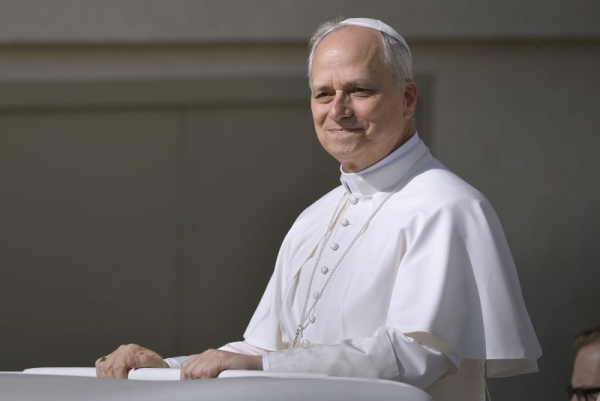
1 of 4 | “Today I renew a strong appeal both to the parties involved and to the international community, that an end be put to the conflict in the Holy Land, which has caused so much terror, destruction and death,” the American-born Pope Leo (pictured May 18 in St Peter’s square, the Vatican) said Wednesday as he again issued an impassioned plea for peace in Gaza and release of around 50 Israeli hostages still held captive by Hamas. File Photo by Stefano Spaziani/UPI | License Photo
Pope Leo XIV joined other religious leaders again calling for a cease-fire in Israel’s war in Gaza with Hamas, and urged Prime Minister Benjamin Netanyahu’s government to end its “collective punishment” of Palestinians.
“Today I renew a strong appeal both to the parties involved and to the international community, that an end be put to the conflict in the Holy Land, which has caused so much terror, destruction and death,” the American-born Pope Leo said Wednesday during his weekly audience in the Vatican attended by thousands.
The U.S. native and leader of the Catholic Church’s billions of religious faithful joined his voice with the head of the Greek Orthodox Church in Israel, Patriarch Theophilos III, and Cardinal Pierbattista Pizzaballa as the pope’s representative in Jerusalem.
“It seems that the Israeli government’s announcement that ‘the gates of hell will open’ is indeed taking on tragic forms,” the patriarchs wrote Tuesday in their statement.
They called for peace in the war-torn Gaza Strip where international groups have declared a state of famine, and urged Hamas to release the remaining 50 Israeli hostages kidnapped by the terror syndicate over 20 months ago.
On Wednesday, the Vatican’s chief was interrupted twice by applause as he read his latest plea for peace in the Vatican auditorium.
He begged for a permanent cease-fire, the safe entry of humanitarian aid to be facilitated “and humanitarian law to be fully respected.”
The pontiff, 69, cited international law and its obligation to “protect civilians and the prohibitions against collective punishment, the indiscriminate use of force and the forced displacement of populations.”
Israeli Prime Minister Benjamin Netanyahu claimed Israel will launch its ground offensive in Gaza City while it pursues peace. However, reports indicate Israel has yet to send emissaries to negotiate.
Reports indicate malnutrition kills dozens daily in Gaza with 92% of malnourished infants aged six months to two years, and that nine in 10 Palestinians have been displaced by Israel with nearly 100% of Gaza destroyed and a half million children without schools or stability.
The two patriarchs on Tuesday called for the end of “senseless and destructive war,” but all three were critical of Netanyahu’s plan to resettle millions of Palestinian refugees in other nations.
They stated since the outbreak of Israel’s expanded war in Gaza with Iran’s terror proxy group Hamas that the Greek Orthodox compound of Saint Porphyrius and the Holy Family compound has been a refuge for “hundreds” of elderly, women and Palestinian children.
A Catholic Church in Gaza was recently hit by IDF shelling that killed three and injured its priest.
“Leaving Gaza City and trying to flee to the south would be nothing less than a death sentence,” they wrote. “For this reason, the clergy and nuns have decided to remain and continue to care for all those who will be in the compound.”
The world’s 267th pope in the Catholic Church’s 2,000-year history followed in the footsteps of his much-beloved late predecessor, Pope Francis, in pleading for global peace.
Since assuming the Chair of Saint Peter in May, Pope Leo XIV has called for an end to growing global war multiple times and pointed a finger at heads of state for a failure to provide much-needed humanitarian aid amid accusations of Palestinian genocide by Israel.
“I renew my heartfelt appeal to allow the entry of dignified humanitarian aid and to put an end to the hostilities, whose heartbreaking price is paid by the children, elderly and the sick,” Leo said in May to tens of thousands of Catholic faithful during his first general audience in St. Peter’s Square.
That month he told over 1,000 journalists “the way we communicate is of fundamental importance.”
“We must say ‘no’ to the war of words and images; we must reject the paradigm of war,” he said.
