

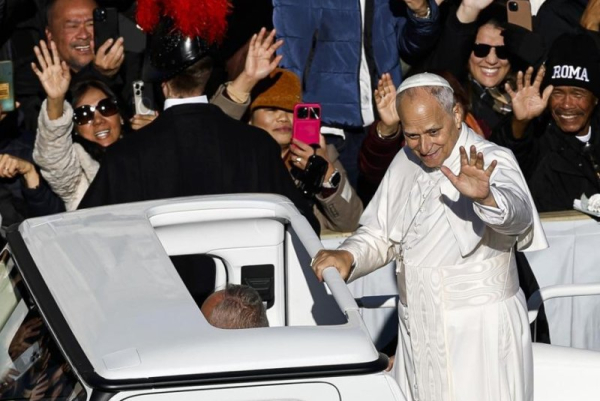
Pope Leo XIV arrives for the holy mass for the Jubilee of Choirs and Choral Society in Saint Peter’s Square in Vatican City on Sunday. His trip to Turkey and Lebanon begins Thursday. Photo by Angelo Carconi/EPA
Pope Leo XIV has opted for war-torn, crisis-ridden Lebanon as part of his first official trip abroad, aiming to call for unity and to help preserve the tiny Arab country — home to the region’s largest Christian population — while also delivering a message of peace to a conflict-ridden Middle East.
Leo, elected last May as the first U.S.-born leader of the Catholic Church, is scheduled to arrive in Beirut on Sunday for the second leg of his Apostolic Journey, which will first take him to Turkey to mark the 1,700th anniversary of the First Council of Nicaea.
His packed schedule in Lebanon includes meetings with the country’s top officials and Catholic Patriarchs and visits to the Monastery of Saint Maroun and the Shrine of Our Lady of Lebanon.
He also has scheduled an ecumenical and interreligious gathering, a meeting with some 12,000 young people, a moment of silent prayer at the site of the 2020 Beirut port explosion and the celebration of holy mass.
Monseigneur Michel Aoun, the official ecclesiastical coordinator for Leo’s visit to Lebanon, said the pope chose this particular moment to express support for the Lebanese people and offer them hope amid “critical conditions.”
The Lebanese, still reeling from their country’s financial collapse, scarce international funding and a continued Israeli war aimed at forcing Hezbollah’s complete disarmament, have nearly lost faith in the possibility of a better future for their nation amid new Israeli plans to reshape the Middle East.
Moreover, they remain mired in deep political and sectarian divisions, confront mounting security concerns and face the threat of increasing social fragmentation.
Invoking John Paul II’s description of Lebanon as “more than a country; rather a message of freedom and an example of pluralism for East and West,” Aoun said Leo’s visit is meant to reaffirm the country’s identity “as a message” and its spirit of “coexistence.”
“He is also coming to give us new hope, especially to the desperate youth,” Aoun told UPI, adding that the visit will attract world attention to Lebanon, widely ignored for its failure to disarm Hezbollah, reclaim lost sovereignty, and implement political and economic reforms.
To Karim Bitar, a lecturer in Middle East Studies at Sciences Po Paris, Leo’s visit carries “huge symbolic weight,” coming at a time when “existential angst” among all Lebanese –and particularly among Christians — is at an all-time high.
Bitar said historically the Vatican — which he described as “one of the last moral authorities in the world” — always has been a principal protector of Lebanon’s national unity and played a key role in preserving “the Lebanese formula” of pluralism and freedom, particularly during the country’s darkest periods, including the 1975-1990 civil war and its aftermath.
“All other states have political, strategic or economic interests,” he told UPI.
He warned that Greater Lebanon, created in 1920 with the endorsement of the Maronite Church, “is at risk today” due to regional turmoil and the interference of regional powers under the pretext of protecting minorities, as well as in Syria, “where Israel is exploiting the existential fears of the Druze and Kurds to encourage fragmentation.”
Leo’s message will be to remind Christians, especially, “once again, not to fear,” and to work toward a new social contract grounded in political equality, social justice and economic development — values Bitar said “are very close to the new pope’s heart.”
Israel’s recent escalation of attacks on Lebanon, including Sunday’s assassination of a Hezbollah commander in Beirut’s southern suburbs, sparked news reports suggesting the pope might cancel his trip. The reports were quickly denied.
“No postponement … He is coming to call for peace, to say enough with wars,” Aoun said, adding that the pope is also expected to address all parties in the Middle East, with special messages for Gaza, Syria and the holy sites.
But to Israeli Prime Minister Benjamin Netanyahu, Iranian officials and Syrian President Ahmad Sharaa, “his words will fall on deaf ears,” Bitar said.
He warned that unless the Lebanese regain hopes, stop being manipulated by foreign countries and overcome the grip of fear, regional wars could ultimately destroy their country.
“The pope has very little influence on geopolitics, but huge influence on the morale of Lebanese Christians,” he said.
