
Portugal’s low-cost unmanned carrier strategy highlights a shift toward AI-driven naval warfare as South Korea faces pressure to accelerate development of drone-centered maritime platforms


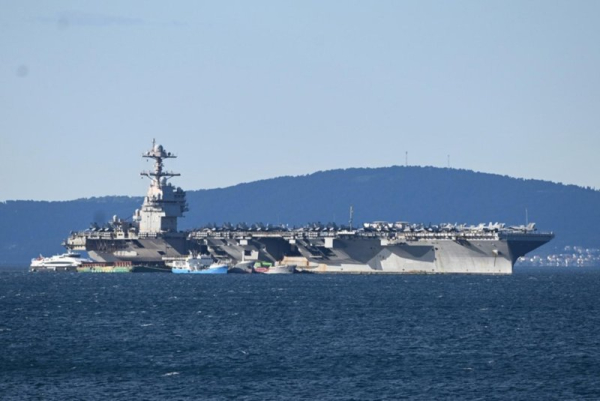
The US Navy aircraft carrier USS Gerald R. Ford (CVN-78) sits anchored in Split, Croatia, 29 March 2026. Photo by STRINGER / EPA
The global naval balance is rapidly shifting away from ultra-expensive warships toward AI-enabled unmanned platforms designed for asymmetric, low-cost warfare, defense analysts say.
The warning signal emerged from Europe after Portugal launched what is being described as Europe’s first dedicated drone carrier, raising new questions about whether South Korea’s Navy is moving fast enough to adapt to future naval combat.
The vessel, named the NRP D. Joao II, was launched April 7 at a shipyard in Galati, Romania. The ship was ordered by the Portuguese Navy and designed and built by Dutch shipbuilder Damen Group.
The 353-foot vessel, with a displacement of between 7,000 and 9,000 tons, is scheduled for delivery to the Portuguese Navy later this year for sea trials.
Defense experts say the ship has attracted international attention not because it is Europe’s first drone carrier, but because of its unusually low cost compared to its capabilities.
The vessel reportedly cost about 132 million euros, or about 190 billion won ($140 million), to build. That is less than 1% of the estimated cost of a U.S. Gerald R. Ford-class nuclear-powered aircraft carrier, which can exceed 20 trillion won ($14.7 billion).
The ship also costs roughly one-seventh as much as South Korea’s latest Jeongjo the Great-class Aegis destroyers.
The project received financial support from the European Union’s post-pandemic Recovery and Resilience Facility, allowing Portugal to pursue what analysts describe as a “reverse approach” to naval power — combining relatively inexpensive platforms with advanced unmanned systems.
Though the vessel resembles a small logistics or support ship externally, its internal structure was designed specifically to coordinate multi-domain unmanned warfare.
Its 308-foot flight deck includes a catapult launch system capable of supporting fixed-wing surveillance drones and loitering munitions.
Below deck, the ship carries facilities for unmanned underwater vehicles, unmanned surface vessels, helicopters and special operations craft, allowing it to function as a command platform for what some analysts call a “ghost fleet.”
The vessel’s manpower requirements are also drawing attention.
Only 48 permanent crew members are needed to operate the ship and its systems, compared with 300 to 400 personnel typically required for large combat vessels. Additional space is reserved for 42 mission specialists, including drone operators and maritime scientists.
Military analysts say the staffing model may offer lessons for countries facing shrinking military-age populations, including South Korea and other East Asian nations.
The development comes as South Korea continues debating whether to pursue a light aircraft carrier program or focus on smaller unmanned naval platforms better suited for coastal and asymmetric warfare.
Critics argue the South Korean Navy has remained too focused on acquiring large, expensive surface combatants despite evolving battlefield realities demonstrated in the Russia-Ukraine war.
Ukrainian drone attacks against Russian naval assets in the Black Sea showed that relatively inexpensive unmanned systems could destroy far more costly warships.
Analysts say South Korea, which possesses world-class shipbuilding capabilities and growing AI and drone technologies, could develop similar drone-centered naval platforms domestically.
The South Korean Navy is currently pursuing an AI-based manned-unmanned teaming strategy known as “Navy Sea Ghost,” aimed at integrating autonomous systems into future naval operations.
Major South Korean defense firms including Hanwha Aerospace and Hyundai Rotem are expanding investment in unmanned combat systems and intelligent warfare technologies.
Analysts say the primary obstacle may no longer be technology, but institutional resistance to shifting away from traditional fleet structures.
For South Korea, which depends on maritime shipping routes for more than 90% of its key raw material imports including oil, protecting sea lines of communication remains a critical national security priority.
Defense experts say Portugal’s experiment demonstrates how middle-sized naval powers may increasingly favor agile, lower-cost unmanned platforms over traditional capital ships as military budgets tighten and personnel shortages worsen.
— Reported by Asia Today; translated by UPI
© Asia Today. Unauthorized reproduction or redistribution prohibited.
Original Korean report: https://www.asiatoday.co.kr/kn/view.php?key=20260516010004325
