


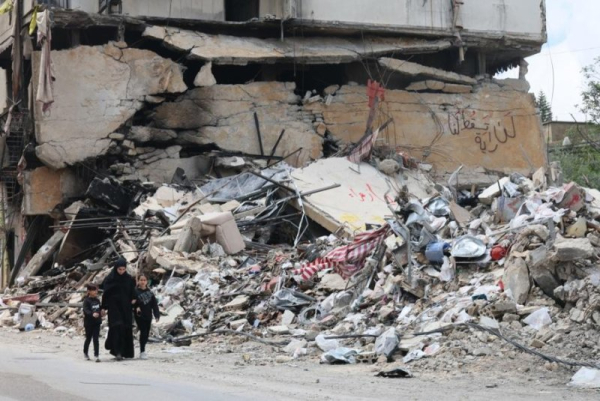
People walk on Tuesday past the rubble of a building damaged in an Israeli airstrike in Jibchit village, southern Lebanon. Israel and Lebanon have agreed to a 10-day cease-fire, which went into effect April 16. Photo by Wael Hamzeh/EPA
A temporary, 10-day cease-fire, which halted six weeks of intensified Israel-Hezbollah conflict, has revealed the scale of the human and material toll on Lebanon, including widespread, Gaza-style destruction across dozens of border villages in the southern portion of the country.
The brief lull did not stop Israel from pursuing what military observers describe as a “scorched-earth” policy to establish a 6.2-mile-deep military zone inside southern Lebanon, gradually wiping out entire villages and flattening or burning properties across some 55 villages within its self-proclaimed “Yellow Line.”
More people have been killed or injured in Israeli airstrikes and bombardments since the cease-fire took effect April 17, prompting Hezbollah to respond days later with rocket fire and drones.
On Thursday, the Lebanese Ministry of Public Health released updated figures showing that 2,483 people have been killed and 7,707 injured since March 2.
Its latest casualty breakdown April 17 indicated that the dead included 177 children, 274 women and some 100 healthcare workers.
Journalists and media workers were not spared, with eight killed in Israeli strikes that, according to press freedom groups, targeted members of the media.
The displaced, who flocked back to southern Lebanon by the thousands once the cease-fire was announced, were met with a grim reality: the scale of destruction inflicted on their homes and villages was beyond imagination.
Many, however, were unable to reach their villages within the “Yellow Line,” where aerial footage, satellite images and videos show widespread Israeli demolitions that have reduced entire areas to rubble, rendering them largely unrecognizable.
They are among the roughly 600,000 residents whom Israeli Defense Minister Israel Katz said would be strictly prohibited from returning until the security of northern Israel is ensured.
Demolitions were accelerated on the orders of Katz, who said that all homes in Lebanese border villages would be destroyed “in accordance with the Rafah and Beit Hanoun model in Gaza” to establish a military zone inside Lebanon.
The Israeli army said the destruction of property was carried out on grounds of imperative military necessity, alleging that Hezbollah had embedded military infrastructure within civilian areas — a claim that is often unsubstantiated and disputed by critics, who cite the scale of destruction and the large number of civilian casualties.
Worse still, Israeli soldiers have been looting significant amounts of civilian property from homes and businesses in southern Lebanon, according to a report published Thursday by the Israeli newspaper Haaretz, which cited testimonies from Israeli army soldiers and commanders.
Haaretz reported accounts describing the widespread theft of motorcycles, televisions, paintings, sofas and rugs, saying the practice has become routine, with no disciplinary action taken to curb it.
Fear that the cease-fire — set to expire Sunday unless extended — would not hold was an additional factor prompting displaced people to head back to their temporary shelters in Beirut and other parts of Lebanon.
United Nations High Commissioner for Refugees spokeswoman Lisa Abou Khaled acknowledged the “cautious movements of return,” taking place in “very challenging conditions,” amid extensive damage to towns, villages and homes, and limited access to basic services, with schools, hospitals, water and electricity severely affected.
“This moment reflects hope combined with uncertainty. People want to return home, but safety remains the overriding concern,” Abou Khaled told UPI, noting that safety risks include “unexploded ordnance in many residential areas across south Lebanon.”
As the Israeli army issued a “no return” order south of the Litani River, she emphasized that under international human rights law, displaced persons retain the “right to voluntary, safe and dignified return once conditions permit.”
However, Israel’s systematic demolitions, which are making the region uninhabitable, significantly complicate the process.
Hashem Haidar, president of the Council of the South, said Israel is implementing a “criminal and savage scorched earth” policy to empty the border region of “humans and everything else.”
Haidar added that the destruction of houses and civilian infrastructure, including electricity and water installations, was being carried out “without any military justification.”
“Every village or house in south Lebanon has been damaged, schools have been destroyed, and entire villages and neighborhoods have been wiped out,” Haidar told UPI, noting that accurate damage assessment is difficult while the war continues, but estimating that it is at least three times greater than during the 2023-2024 war between Israel and Hezbollah.
However, efforts have begun to clear and reopen roads linking the villages, remove rubble and construct alternative crossings and passages to replace destroyed bridges because “people are determined to go back,” he said.
According to the National Council of Scientific Research, more than 62,000 housing units were destroyed by Israel during the recent 46-day war with Hezbollah, with 21,700 units gone and 40,500 others damaged.
This adds to the 220,000 housing units destroyed or damaged during the 2023-2025 war period, as well as to the $11 billion estimated by the World Bank that is needed for Lebanon’s reconstruction and recovery after the 14-month Israel-Hezbollah war in 2023-2024.
Finance Minister Yassine Jaber initially estimated in published remarks that the destruction recorded in March amounted to about $1.5 billion, a figure expected to increase considerably due to the intensified bombardment in April, which destroyed additional villages, bridges and buildings in Beirut and its southern suburbs.
Tarek Mazaraani, a civilian engineer who assisted in assessing the damage inflicted in the previous war, said residents of southern Lebanon, especially in the border area, have resorted to videos and Google Maps images supplied by family members living abroad, as well as videos released by the Israeli army of its demolitions, to determine the status of their properties.
Mazraani said the border villages and towns today appear to have been almost destroyed by Israeli air and drone strikes, bulldozers and the rigging of houses with explosives “in a way to prevent their inhabitants from returning, making the area unlivable and free of population for a long time.”
“It is a kind of revenge against those villages, wiping out their geography, demography, history and memories,” he told UPI, citing the destruction of their agricultural land, 100-year-old olive trees, schools, hospitals, mosques and government institutions, “10 times more than the previous war.”
He cited the village of Houla on the border with Israel, where 10 to 15 houses were destroyed during the 2006 Israel-Hezbollah war, compared to 1,000 today.
The 1.2 million displaced, like most Lebanese who have been exhausted by the continuing war for three years now, aspire to an effective cease-fire that could stop Israel’s destruction, secure their return and eventually end the conflict for good.
Until then, humanitarian needs would remain significant, both for those returning and for those who remain displaced or risk being displaced again, according to Abou Khaled.
Post-war reconstruction emerges as the top challenge, requiring commitment and substantial funding from donor states — especially Gulf countries — a move Haidar expects to materialize once a lasting settlement is achieved.
