


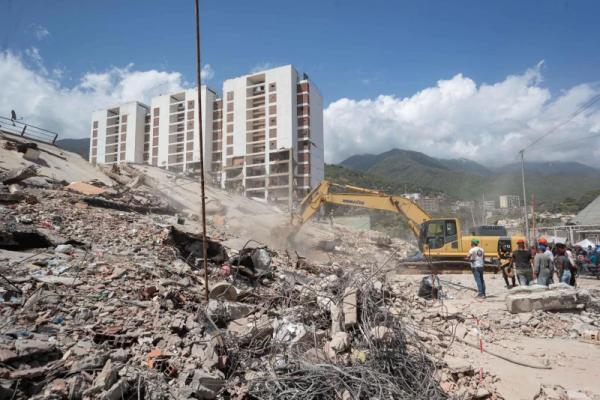
Volunteers conduct search operations in a building damaged by an earthquake in La Guaira, Venezuela, on Monday. National and international rescue teams continue their efforts among the ruins of buildings in the coastal state of La Guaira, north of Caracas, the epicenter of devastation caused by 7.2- and 7.5-magnitude earthquakes. Photo by Ronald Pena R/EPA
Five days after the twin earthquakes that left thousands of victims in Venezuela, rescuers and volunteers said government-imposed restrictions are hindering operations to search for survivors, as a magnitude 4.6 aftershock struck the country again Monday.
The complaints began after Interior, Justice and Peace Minister Diosdado Cabello announced restrictions on access to La Guaira state, the area hardest hit by the magnitude 7.2 and 7.5 earthquakes that struck Wednesday.
Since Friday night, anyone wishing to enter the area to assist has been required to register in Caracas and obtain official authorization, a measure the government said was necessary to ensure the passage of ambulances, heavy machinery and specialized teams.
“Starting today at 8 p.m., access to La Guaira state will be restricted. Anyone wishing to come must comply with the established protocols,” Cabello said in remarks broadcast on state television channel VTV.
He added that authorities “will be making decisions along the route to prevent people without assigned duties from entering.”
The decision drew criticism from volunteers and rescuers, who argued that the new controls are delaying the arrival of personnel and supplies to the area hardest hit by the disaster during the most critical hours for locating people trapped beneath the rubble.
The tensions became evident during a search operation in La Guaira, where a member of a U.S. rescue team repeatedly asked Cabello to step away from the work perimeter so rescue efforts could continue.
Videos circulated on social media show the rescuer saying, “Back up, back up,” while pointing toward an area where, he said, a person was still calling for help from beneath the rubble.
Before leaving, the rescuer said: “I’m not happy with this situation.”
Diosdado Cabello, communist and socialist murderer, get out of the way and let the rescue teams save lives.
This is not the time for politics, control, or bureaucracy. This is the time to rescue the men, women, and children who remain trapped beneath the rubble. Every minute… pic.twitter.com/4J4ppDDaAn— Dariel Fernandez (@darielfernandez) June 29, 2026
In an interview with Venezuelan journalist Elder García, Chilean rescuer Francisco Fermanda said the international community had responded efficiently and effectively to the country’s request for assistance, but drew attention to “the complete lack of organization on the part of the Venezuelan government.”
“I have 46 rescuers working in La Guaira who can’t even leave the area to charge their phones, for example, because the military won’t let them back in,” he said.
Fermanda described the earthquake in Venezuela as one of the most devastating he has ever seen, making it difficult to understand why rescue teams from Spain and France were unable to enter the country because they lacked visas.
“When international assistance is requested, there is usually flexibility regarding the entry and processing of rescue teams, because the priority is preserving lives and taking advantage of the golden hours to begin searching for survivors,” the rescuer said.
Rep. Maria Elvira Salazar said in a post on X that “it is criminal that Delcy Rodríguez and her regime continue blocking the entry of international rescue teams and humanitarian aid while Venezuelans remain trapped beneath the rubble.”
Es criminal que Delcy Rodríguez y su régimen sigan bloqueando la entrada de equipos internacionales de rescate y ayuda humanitaria mientras hay venezolanos atrapados bajo los escombros.
Deben permitir su ingreso de inmediato. Cada minuto de demora cuesta vidas.— Rep. María Elvira Salazar (@RepMariaSalazar) June 28, 2026
After waiting two days at Bogotá’s airport, the Spanish rescue team USAR13 decided to return to Spain after failing to obtain permission to travel to Venezuela.
“For different reasons, #usar13 cannot fly, just like many other teams. Seeing that this situation will continue, we have decided to return home.
“We leave with great sadness because we were unable to help and do our small part for the Venezuelan people,” the team wrote on X.
Por diferentes motivos, #usar13 no puede volar, al igual que muchos otros equipos, y viendo que esta situación se alargará en el tiempo hemos decidido volver a casa. Nos vamos con mucha pena por no haber podido ayudar y aportar nuestro granito de arena al pueblo venezolano. pic.twitter.com/MKW0BZBVhc— U.S.A.R.13 (@USAR13DYA) June 27, 2026
Social media has also been filled with criticism of the role played by the Venezuelan military during the crisis caused by the disaster. Residents have expressed deep frustration over the military’s inaction in search operations and the blocking of volunteer rescuers.
While hundreds of volunteers and international rescuers race against time to save lives, videos circulating on social media show citizens confronting armed personnel for prioritizing street control with weapons over clearing rubble.
In several affected areas, including La Guaira state, residents have confronted security forces, demanding that they replace their rifles with shovels, newspaper El País reported.
Public anger has also been directed at security forces, including the Bolivarian National Guard and the National Police, after multiple videos circulated on digital platforms allegedly showing officers taking household appliances, food and cash from collapsed buildings and destroyed businesses.
Journalists from international media outlets have also reported that, for the second consecutive day, Venezuela’s Ministry of Communication suspended transportation for international reporters to La Guaira after making them wait in a press room set up in Caracas.
Ministry of Communications in Venezuela not communicating. Is there a press trip or not? Can we enter by ourselves or not? Teams are leaving to try to get to La guaira themselves as fed up at the lack of information or at least someone saying there is delay. Zero communication. pic.twitter.com/WBv7Eul8YC— Catherine Ellis (@Cat_lucy1) June 29, 2026
Univision journalist Paulina Sodi said the international press had been summoned early Saturday to be registered. They were also informed they would receive a special visa and would be transported to La Guaira aboard government buses to report from the disaster zone.
However, they were not told on which day or at what time that would happen. On Monday, that possibility was postponed for another 48 hours on the grounds that aftershocks such as the one recorded Monday made it unsafe to visit La Guaira.
