

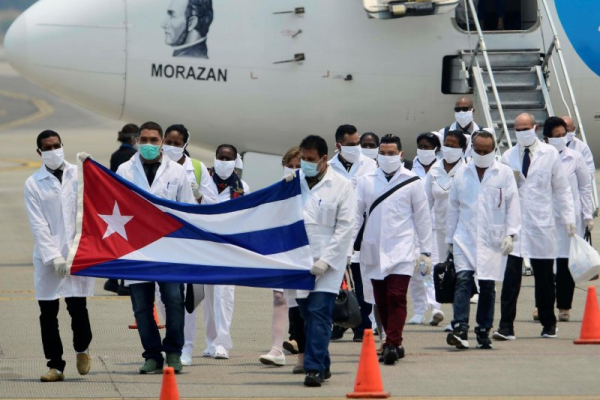
The Inter-American Commission on Human Rights issued a formal warning over serious labor and human rights violations in Cuba’s overseas medical brigades, saying some cases may amount to forced labor or “contemporary forms of slavery.” File Photo by Jose Valle/EPA
The Inter-American Commission on Human Rights issued a formal warning over serious labor and human rights violations in Cuba’s overseas medical brigades, saying some cases may amount to forced labor or “contemporary forms of slavery.”
The report released Tuesday, is based on 71 testimonies from former brigade members and a review of Cuban regulations against international standards. It identifies recurring practices affecting wages, professional mobility, working conditions and personal life.
The Inter-American Commission on Human Rights said it does not consider these testimonies isolated cases. The report itself warns that a “widespread fear of reprisals” limits access to additional complaints and reflects the coercive environment in which brigade professionals carry out their work.
Cuba launched its international medical missions in 1963. Since then, the program has grown into what the report describes as the country’s main source of state revenue, based on exporting health services through bilateral agreements with host countries.
According to official figures cited by the commission, human health and social care services generated $4.882 billion in 2022, a 12% increase from the previous year and accounting for 69% of total service exports. Those revenues were nearly four times higher than exports of goods.
Data for 2023 grouped health services with “personal, cultural and recreational services,” without separating categories, for a total of $4.449 billion.
Despite the scale of revenues, the report says medical professionals receive between 2.5% and 25% of the payments made by host countries, with the remainder retained by the Cuban state. As a result, the commission concluded that many workers “do not receive remuneration that allows them to live with dignity.”
According to data from Cuba’s Ministry of Public Health statistical yearbook, 56 countries hosted Cuban medical brigades in 2024, including 19 in Latin America. About 23,000 health professionals were deployed in these missions.
In recent months, several countries in Latin America and the Caribbean have begun ending or reviewing cooperation agreements with Cuba, raising concerns about how the programs operate and the labor conditions involved.
These shifts come as the United States increases pressure on regional governments to reassess contracts with Cuban medical brigades, citing concerns over labor exploitation and restrictions imposed on professionals working abroad.
The commission acknowledged the importance of the services provided by Cuban health workers, particularly in delivering essential care to vulnerable populations.
However, it said many contracts fail to specify key conditions, are not subject to negotiation and are often only fully understood by workers upon arrival in the host country.
Based on documented practices including wage withholding, limits on movement, institutional pressure and economic and migration-related consequences for workers and their families if they abandon missions, the report concludes that some conditions in Cuban medical brigades are consistent with forced labor and modern slavery.
The government of Cuba has repeatedly rejected allegations of labor abuses in its medical missions, describing them as a “smear campaign” led by the United States to undermine its international services.
