

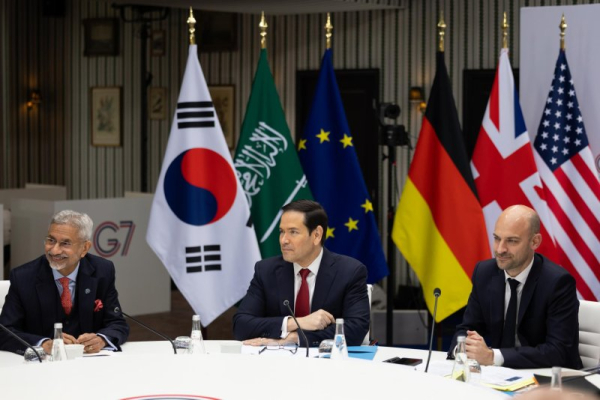
U.S. Secretary of State Marco Rubio (C) flanked by French Minister for Europe and Foreign Affairs Jean-Noel Barrot (R) and Indian Foreign Minister Subrahmanyam Jaishankar on Friday at a meeting of the G7 in Vaux-de-Cernay near Paris. Photo by Philemon Henry/EPA
U.S. Secretary of State Marco Rubio was in Paris on Friday for a gathering of G7 foreign ministers where the war with Iran was expected to dominate the agenda.
Before departing Washington, Rubio said partners in the group of advanced economies — which include Britain, France, Germany, Italy, Japan and Canada — should “step up” and help secure the Strait of Hormuz because they had a great interest in doing so.
“Very little of our energy comes from the Strait of Hormuz. It’s the world that has a great interest in that, so they should step up and deal with it,” Rubio told reporters Thursday.
“There was a couple of leaders in Europe who said that this was not Europe’s war. Well, Ukraine is not America’s war, and yet we’ve contributed more to that fight than any other country in the world.
“I’m not there to make them happy. For all the countries who care about international law, they should be doing something about it,” he added.
A French foreign ministry agenda seen by The New York Times for the meeting in Vaux-de-Cernay, 25 miles southwest of Paris, includes talks on efforts to end the war, Iran’s nuclear and ballistic missiles programs and making safe the key Hormuz Strait sea route via which 20% of global oil and gas supplies is exported.
The United States’ G7 partners — all of whom with the exception of Japan are NATO members — have politely declined U.S. President Donald Trump’s request that they send warships to help restore maritime traffic in the strait, which Iran has effectively closed.
European foreign ministers were expected to push for a compromise — help with the strait in exchange for de-escalation as fears continue to mount over the impact the Iran war is having on the world economy and the direction of a war much closer to home: Ukraine.
“We need to see a swift resolution to this conflict that restores the regional stability, that needs to include the Strait of Hormuz,” British Foreign Secretary Yvette Cooper said as she went into the meeting.
European Union foreign policy chief Kaja Kallas said Europe wanted an exit strategy to avoid unintended consequences negatively impacting Ukraine’s ability to hold Russia at bay, including surging energy costs, with Brent Crude trading above $110 a barrel in mid-afternoon trade in London on Friday.
“This oil price hike is giving Russia the possibility to fund this war again, which is really not good for the Ukrainians,” she said.
This week in Washington
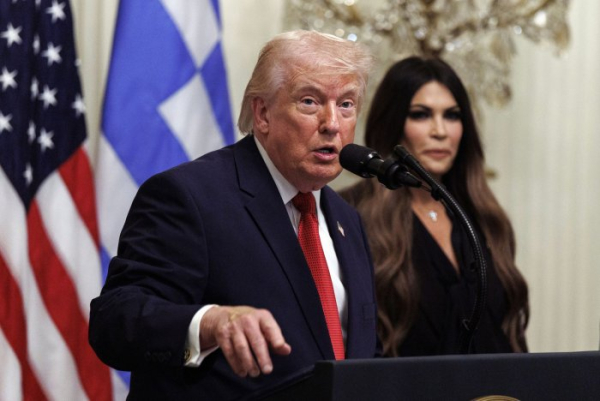
President Donald Trump and U.S. Ambassador to Greece Kimberly Ann Guilfoyle attend a Greek Independence Day celebration event in the East Room of the White House on Thursday. Photo by Will Oliver/UPI | License Photo
