


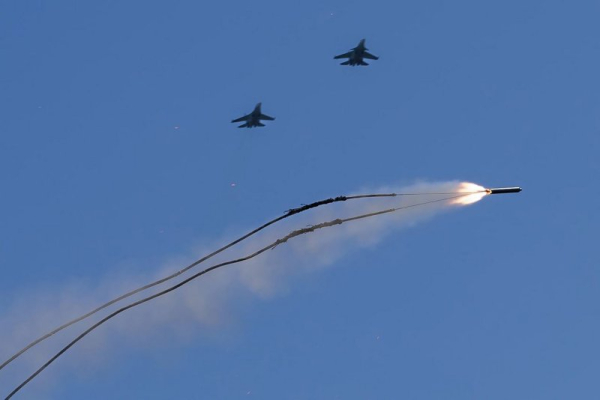
Two days’ of large-scale Russian air, sea, and terrestrial military exercises with Belarus got underway Tuesday in preparation to deploy nuclear forces in the event of an “aggression threat.” File Photo by Russian Ministry Defense/UPI | License Photo
Russia embarked on two days of large-scale air, sea, and terrestrial military exercises with Belarus on Tuesday to practice preparing to deploy nuclear forces in the event of an “aggression threat,” Moscow said.
The drills involving 64,000 troops, 7,800 armament pieces, 200 missile launchers, more than 140 aircraft, 73 ships and 13 submarines, including eight strategic nuclear deterrent submarines, will see test-firings of ballistic and cruise missiles across Russia, the state-run TASS news agency said.
The exercise combines the Strategic Missile Force, the Northern and Pacific Fleets, the long-range aviation military command and some military districts with the goal of refining skills and command and control preparedness to implement deterrence, “prevent aggression” and test the ability of forces and logistics to work together to deliver specific goals, said TASS.
“The drills are set to practice readying some of nuclear forces’ units and formations for accomplishing assigned objectives and rendering them comprehensive logistical support, and also carrying out test-launches of ballistic and cruise missiles at practice range,” the report said.
The operation will also practice working with Belarus on preparation and deployment of Russian nuclear weapons stationed in Belarus.
The Belarus Defense Ministry confirmed drills for the “combat use of nuclear weapons and nuclear weapons logistical support” involving missile troops and the air force had got underway on Monday but stressed the exercises with Russian forces were a “scheduled, planned,” event not targeted at any country and that posed no threat to regional security.
Ukraine, which has a long border with Belarus used by Russia to launch its initial offensive when it invaded in February 2022, condemned the exercises and basing of nuclear weapons in Belarus as “an unprecedented challenge to the architecture of global security.”
“The joint strike exercises directly violate the fundamental Articles 1 and 2 of the Treaty on the Non-Proliferation of Nuclear Weapons, which strictly prohibit nuclear-weapon states from transferring control of technologies of mass destruction, and non-nuclear signatories from accepting them,” the Ministry of Foreign Affairs wrote in an online post.
“By turning Belarus into its nuclear bridgehead near NATO borders, the Kremlin is de facto legitimizing the spread of nuclear weapons in the world and setting a dangerous precedent for other authoritarian regimes. Such actions should be unequivocally and strongly condemned by all states that respect the nuclear non-proliferation regime.”
After 27 years of nuclear-free, post the break-up of the Soviet Union, during which Belarus was a signatory to the NPT, Russia began deploying tactical nuclear weapons in Belarus in June 2023.
The stockpile was thought to include nuclear warheads for Iskander-M missile systems and aerial bombs for Su-25 and Su-30 fighters delivering nuclear warheads with a yield of 5 to 50 kilotons over a 310-mile maximum range.
Smaller 15 to 20 kiloton free-fall nuclear bombs for SU-25 attack aircraft delivered over a 220-mile maximum range were also believed part of the arsenal.
Russian President Vladimir Putin has repeatedly stated that Moscow retains full control over the weapons in line with the NPT, which prohibits the transfer of control over weapons to third countries.
Putin has threatened on numerous occasions since Russia’s full-scale invasion of Ukraine that Moscow would not hesitate to use nuclear weapons if its sovereignty is jeopardized.
He suspended Russian participation in the New Strategic Arms Reduction Treaty in February 2023 — continuing to adhere to central nuclear weapons limits but halting on-site inspections and data sharing — and pulled out of the Comprehensive Test Ban Treaty completely nine months later.
In September 2024, Putin attempted to prevent the United States from authorizing Ukraine to use U.S.-supplied missiles to strike deeper into Russian territory by threatening to change nuclear engagement rules so that an attack from a non-nuclear adversary backed by a nuclear ally would be considered a “joint attack.”
Historic May moments through the years

Wreathes are seen amongst the statues at the Korean War Veterans Memorial during Memorial Day weekend in Washington on May 27, 2023. Memorial Day, which honors U.S. military personnel who died while in service, is held on the last Monday of May. Photo by Bonnie Cash/UPI | License Photo
