


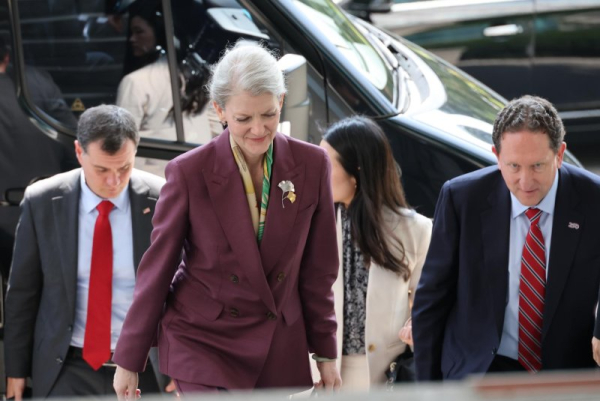
1 of 2 | U.S. Under Secretary of State for Political Affairs Allison Hooker (C) arrives at South Korea’s foreign ministry building in Seoul on Tuesday for talks on security-related agreements. Photo by Yonhap
South Korea and the United States launched new high-profile talks Tuesday to discuss the implementation of security agreements reached by their leaders, including Seoul’s push to acquire nuclear-powered conventionally armed submarines.
The first day of the two-day inaugural talks focused on security-related provisions laid out in a bilateral joint fact sheet issued following a summit between President Lee Jae Myung and U.S. President Donald Trump in October, according to the South Korean foreign ministry.
“The meeting carries significance in that long-delayed security consultations have finally begun and are back on track,” foreign ministry spokesperson Park Il said at a press briefing.
“Cooperation and partnership between South Korea and the U.S. in the nuclear sector will help deepen and broaden the bilateral alliance,” he added, stressing the government’s commitment to fully implementing the agreed-upon issues.
On the first day of the talks, the two sides reportedly focused on issues related to Seoul’s push to build nuclear-powered submarines, which has been prohibited under a bilateral nuclear pact between Seoul and Washington.
On Wednesday, they are expected to focus their discussions on other security issues, such as Seoul’s uranium enrichment and spent nuclear fuel reprocessing capabilities, which are largely needed to supply fuel for its envisioned nuclear-powered submarines.
Other agenda items for the new security talks include the expansion of shipbuilding cooperation between South Korea and the U.S.
The joint fact sheet, published in November, outlines a range of commitments by both sides, including cooperation in the nuclear sector and other security-related issues, as well as Seoul’s pledge to invest US$350 billion in the U.S. in exchange for a reduced U.S. tariff rate.
First Vice Foreign Minister Park Yoon-joo led the South Korean delegation, which included officials from the presidential office, as well as the defense, science and industry ministries.
The U.S. delegation was led by Under Secretary of State for Political Affairs Allison Hooker and included Ivan Kanapathy, senior director for Asia at the National Security Council (NSC), Matthew Napoli, deputy administrator for defense nuclear nonproliferation at the National Nuclear Security Administration, and other officials from the Department of Energy and related agencies.
Following the inaugural meeting co-chaired by Park and Hooker, detailed discussions were held under the direction of the National Security Office at Cheong Wa Dae and the White House NSC, the ministry said.
The kickoff meeting had initially been expected to take place earlier this year but was delayed as Washington focused on other priorities, including the Middle East conflict.
The U.S. had also raised concerns over delays in Seoul’s legislative process for its investment pledge and a probe into the U.S.-listed e-commerce giant Coupang Inc. over a massive data breach, among other issues.
Despite the delay in launching the consultative body, the two sides have continued working-level discussions and are expected to move quickly into substantive talks at the inaugural meeting, according to the officials.
In a post on X, Hooker said she was “pleased” to launch the discussions “to advance bilateral nuclear cooperation initiatives,” expressing hope for “further deepening and modernizing our cooperation” and “continued progress across the bilateral relationship in the years to come.”
In an interview with Yonhap News Agency last week, Foreign Minister Cho Hyun said South Korea seeks to revise the bilateral nuclear energy pact, known as the 123 Agreement, “as soon as possible” to enable uranium enrichment and spent nuclear fuel reprocessing. The government also hopes to accelerate cooperation in nuclear-powered submarines and shipbuilding.
South Korea is effectively prohibited from enriching uranium and reprocessing spent nuclear fuel under the existing agreement.
Last week, South Korea unveiled a road map for developing nuclear-powered attack submarines fueled by low-enriched uranium, with the first vessel targeted for launch in the mid-2030s.
Meanwhile, Hooker held a separate meeting with Jeong Yeon-doo, Seoul’s vice foreign minister for diplomatic strategy and intelligence, on Tuesday, where the two sides exchanged views on the Korean Peninsula and other issues of mutual interest, according to the ministry.
Hooker was also scheduled to hold meetings with Cho and other senior officials here, it added.
Copyright (c) Yonhap News Agency prohibits its content from being redistributed or reprinted without consent, and forbids the content from being learned and used by artificial intelligence systems.
