


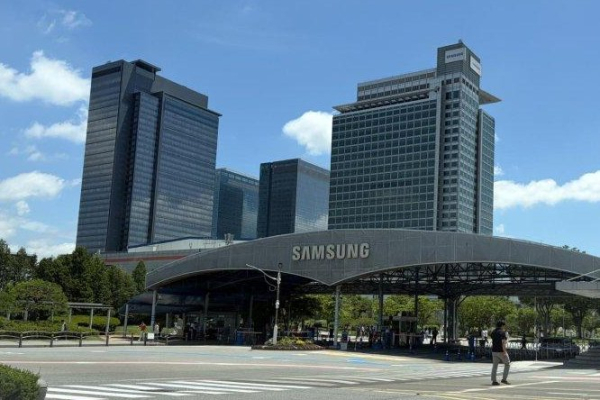
The entrance to Samsung Electronics’ campus in Suwon, South Korea. The memory chipmaker posted record operating profit during the second quarter of this year. Photo by Hyojoon Jeon / UPI
South Korea’s Samsung Electronics has become one of the world’s most profitable companies after posting $59 billion in operating profit for the second quarter of this year.
Boosted by soaring semiconductor prices over the past year, the profit of the world’s leading memory chipmaker, which disclosed Tuesday, surpassed the previous quarterly records set by Apple and NVIDIA.
Market observers said Thursday that the robust earnings momentum of Samsung Electronics is likely to continue as demand for memory chips outpaces supply amid persistent capacity constraints.
“Because of limited production capacity, memory supply will fall well short of matching demand growth at least through the fourth quarter of next year,” Meritz Securities analyst Kim Sun-woo said in a report. “The memory industry has not even reached the midpoint of its current cycle.”
With regard to concerns that the AI boom may be a bubble, which plagues Samsung Electronics investors, Kim dismissed such views.
“Those arguments are merely the lament of a coachman watching the arrival of the internal combustion engine,” he said. “In an era of fierce investment competition to develop artificial general intelligence, adapting to the redistribution of limited supply is inevitable.”
Choi Bo-young, an analyst at Kyobo Securities, concurred. She forecast that the rapid adoption of agentic AI — AI that behaves like an autonomous agent, making decisions to achieve objectives — will keep driving broad-based demand for memory chips, resulting in a structural supply shortage through 2028.
“Samsung Electronics remains the clear market leader in both conventional DRAM and NAND flash memory, with market shares of 38% and 29%, respectively, while leading the recent surge in memory prices,” Choi said.
“In particular, the company’s first shipments of HBM4 to NVIDIA mark the beginning of its serious push to narrow the gap in the HBM market,” he added.
According to market consultancy TrendForce, DRAM prices surged about 60% in the April-June period from the previous three months, while those of NAND flash jumped more than 50% during that span.
Earlier this year, Samsung Electronics beat its competitors to become the world’s first player to launch mass production of the sixth-generation high-bandwidth memory, or HBM4. Toward that end, Samsung Electronics passed NVIDIA’s stringent qualification process.
Samsung Electronics has long been the dominant player in the global memory chip industry. In the lucrative HBM market, however, its domestic rival and the world’s No. 2 maker SK hynix has taken the lead.
Over the past few years, Samsung Electronics has put forth great efforts to catch up with SK hynix in the HBM segment.
Share price fluctuations
Despite Samsung Electronics’ blockbuster earnings, its share price fell 6.92% on Tuesday and 6.25% on Wednesday before edging up 0.18% on Thursday. Over the same period, the benchmark KOSPI fell 4.91% and 5.35%, respectively, before rebounding 0.62%.
“The share price of Samsung Electronics had already risen so much that it became vulnerable to profit-taking,” HMC Investment Securities research head Greg Noh told UPI.
“Even a slight slowdown in momentum prompted many investors to lock in profits, triggering a sharp decline this week. After this short-term correction, I believe that the stock will resume its upward trend,” he said.
Many other brokerage houses also viewed the decline as a buying opportunity rather than a sign of weakening fundamentals.
They argued that it represents a temporary correction within an ongoing bull market, and that Samsung Electronics’ growth momentum would remain intact through the second half of this year.
Son In-jun, of Eugene Investment & Securities, predicted that memory makers will intensify competition to enhance shareholder returns in the second half.
“Samsung Electronics is likely to allocate about half of its annual free cash flow to shareholder returns, primarily through share buybacks and cancellations,” Son said.
“Such large-scale capital return programs should enable the stock to outperform the broader market after its recent period of relative underperformance,” he said.
Son projected that Samsung Electronics would generate an annual operating profit of $235 billion for 2026 and $385 billion for 2027.
HMC Investment Securities also forecast that the chipmaker would post operating income of $250 billion for this year and $370 billion for next year.
