

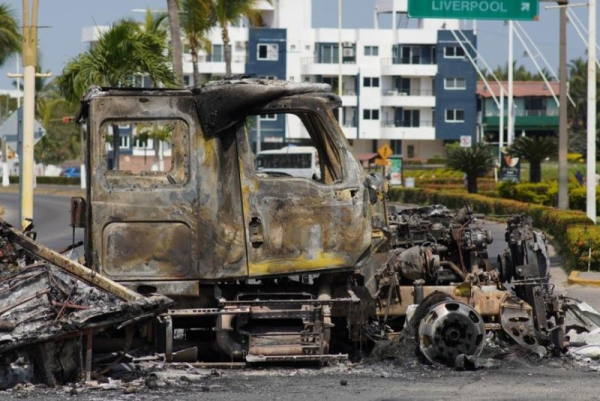
Burned out vehicles are seen on the boardwalk in Puerto Vallarta, Mexico, on Monday. The resort city reported visible disruptions after violence linked to the killing of drug cartel leader Nemesio Oseguera Cervantes, known as El Mencho, in a military operation. Photo by Arturo Montero/EPA
The security crisis in the Mexican state of Jalisco continued Tuesday, with 23 inmates still at large, at least 41 people detained in connection with unrest and new highway blockades.
This turmoil exists despite the deployment of nearly 10,000 military personnel after the death of Nemesio Oseguera Cervantes, known as “El Mencho,” leader of the Jalisco New Generation Cartel.
Twenty-three inmates have remained fugitives for more than 48 hours after an armed attack on the Centro Integral de Justicia Regional (Ceinjure) in Ixtapa, in Puerto Vallarta, facilitated their escape amid the wave of violence that followed the military operation against Oseguera in Tapalpa. A prison guard was killed during the assault.
Jalisco’s security secretary confirmed that the inmates remain at large, and that alerts have been activated in other states to try to recapture them.
Meanwhile, state authorities reported Monday the arrest of at least 41 people for their alleged involvement in disturbances after the cartel leader’s death.
Of that total, 20 are accused of directly participating in violent acts, such as burning vehicles and businesses and attacks on people in public areas, while the rest faced charges related to looting and ransacking over the weekend.
Amid the escalation of violence, the federal government reinforced its presence in the state.
Jalisco Gov. Pablo Lemus Navarro confirmed the action in a message posted on social media platform X: “To support security efforts, the government of Mexico has sent Jalisco 2,500 additional Army personnel who have been deployed in different parts of the state.”
In the same message, he announced a gradual return to normal activities.
“In agreement with the Security Board, I want to announce the return to classes at all educational levels beginning Wednesday. This morning, public transportation is operating normally throughout the state.
“In the Guadalajara metropolitan area, Siteur reports 100% operations, while conventional routes resumed service at 60%. The Mercado de Abastos is operating normally this morning and businesses are open.”
However, despite the call for normalization, new highway blockades were reported Tuesday in several municipalities.
The mayor of Chiquilistlán, Álvaro González Alvarado, said on Facebook that the town awoke once again with roads closed.
“Once again we woke up to blockades in the municipality, specifically on the highway to Capula and on the road toward Colotepec,” he said.
The mayor urged residents to avoid traveling through the area and to remain informed through official channels.
Hours later, the municipal government issued a preventive advisory to temporarily suspend in-person classes at all educational levels, contrasting with the state’s announcement of resumption.
“Due to the security situation that still prevails in the region … the municipal government of Chiquilistlán has issued a preventive advisory … to temporarily suspend in-person school activities,” González wrote.
“In Chiquilistlán, we will not put our girls, boys and young people at risk. The safety of our citizens is and will continue to be our priority,” he said.
At the national level, federal authorities reported that during the operation against Oseguera and subsequent clashes, at least 27 members of the security forces, 46 suspected organized crime members and one civilian were killed. Armed groups blocked highways in 20 states and set fire to vehicles and businesses.
Oseguera, 59, was one of Mexico’s most-wanted drug traffickers, with a $15 million reward offered by the United States. He was Founder of the cartel, and it consolidated into one of the country’s most violent criminal groups.
The violence also affected the tourism sector. In Puerto Vallarta, on Mexico’s Pacific coast and a popular destination for U.S. and Canadian visitors, flight cancellations were reported over the weekend. Governments, including those of the United States, United Kingdom, Canada and Australia, issued or reiterated travel warnings.
Although state authorities say normalcy has returned, the mass prison escape, new blockades reported Tuesday and a possible restructuring of the cartels continue to keep tensions high in Jalisco.
“I’m afraid to go out, but I’m more afraid not to eat,” a taxi driver in Jalisco told Diario Prensa Libre.
