

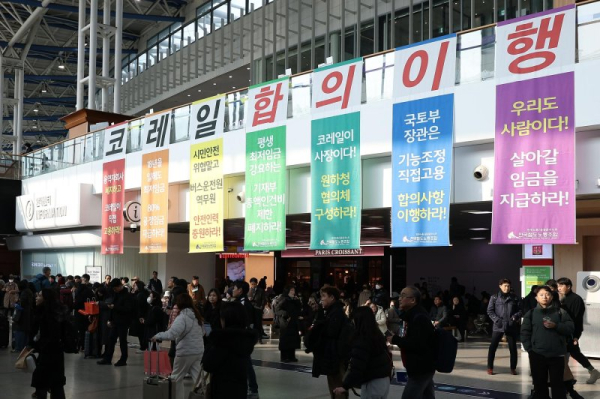
Banners bearing protest messages from unionized rail workers are hung inside Seoul Station in Seoul, South Korea, 10 December 2025, as the union has threatened to launch a general strike on 11 December. Photo by YONHAP/EPA
On Nov. 20, 2019-five days before the Korea-ASEAN Special Summit was set to open-Korail’s railway union announced an open-ended strike. The demands were familiar in Korea’s public-sector labor battles: more staffing, higher pay and, crucially, a structural change-folding SR, the operator of the SRT high-speed line, into Korail’s KTX system.
Yet the strike fizzled after five days.
Part of the explanation was political timing. Few unions relish being blamed for disrupting an international summit. But another reason was simpler and more revealing: SR kept SRT service running normally out of Suseo Station. For passengers, there was an alternative. For the union, there was suddenly less leverage.
That “shock absorber”-competition within high-speed rail-has quietly shaped the last decade of labor politics on the tracks. When Korail labor talks suddenly settled just a day before a planned strike last week, and when a strike and work-to-rule campaign ended after only seven days last December, it was hard to miss the same dynamic: SR offered a bypass. A system with two operators does not eliminate strikes, but it can limit how effectively a strike can hold the public hostage.
Now the government is preparing to dismantle that buffer.
The Ministry of Land, Infrastructure and Transport says it will phase in integration of the KTX and SRT systems by the end of next year, with Korail absorbing SR. That would end-after roughly 10 years-the competition model introduced when SRT launched in December 2016.
Supporters argue the merger will streamline duplicated operations and even make room for a 10% reduction in KTX fares, citing projected annual savings of about 40 billion won (about $30 million) from cutting overlapping functions such as management units, booking apps, payment systems, customer centers and training facilities. It is an appealing promise: one national rail system, fewer redundancies, cheaper tickets.
But rail systems are not spreadsheets. Monopolies have a way of “finding” new costs, especially when political incentives shift and deficits mount. If consolidation leads to weaker service discipline and larger financial shortfalls, fare increases become less a question of “if” than “when.”
That risk is not theoretical. Korea’s own history is a reminder that the competition idea was not born from free-market ideology alone. The Roh Moo-hyun administration began pushing a more competitive structure in 2004, and the approach continued-through the Lee Myung-bak and Park Geun-hye years-into SR’s eventual launch. Public reaction was not broadly negative, in part because competition appeared to deliver something tangible: lower prices. SR has said SRT’s cheaper fares saved the public about 880 billion won (about $660 million) over nine years without fare increases.
It is also why SR’s union has been resisting consolidation. The union argues the problem is not that two operators exist, but that competition has never been fully fair. It points to what it describes as Korail advantages-such as share purchase rights and priority access to depots and stations-and argues that the answer is a level playing field, not a return to a single dominant operator. The union also notes Korail’s debt load, which it puts at 22 trillion won (about $16.5 billion), as a warning sign about the long-term economics of monopoly rail.
To be fair, the government’s roadmap is not without bright spots. A cross-operation plan starting next March would allow passengers to board KTX trains at Suseo Station and SRT trains at Seoul and Yongsan stations. Korail says that could boost daily seat supply by about 16,000 by sending underused Seoul-departing KTX trains to Suseo when SRT sells out. With SRT tickets often requiring reservations weeks in advance, any capacity relief would be felt immediately. KTX-1 sets expected at Suseo carry 955 seats-more than double an SRT set’s roughly 410.
But critics argue that cross-operation is not a substitute for the basic fix: more track capacity. The bottleneck between Pyeongtaek and Osong already runs at about five-minute intervals for through trains on the Gyeongbu and Honam corridors, leaving little room to add service without infrastructure expansion. They also note demand growth has outpaced supply: while combined annual ridership rose from 147.3 million in 2017 to171.49 million last year, the number of high-speed trains operated increased far less. And new SRT trainsets are scheduled to arrive sequentially starting late next year, even without a merger. The new trains are expected to add more seats per set, with a full rollout projected to meaningfully increase daily capacity.
Which raises an uncomfortable question: if the merger’s capacity gains are uncertain, and fare savings may be temporary, what is driving the urgency?
Critics say labor politics is part of the answer. Korail’s largest union is affiliated with the Korean Confederation of Trade Unions, and the Railway Workers’ Union has long opposed competition and sought to absorb SR. If SR disappears as an independent operator, so does the competitive pressure that has blunted strike impact-and a unified labor structure could emerge with even greater bargaining power. Korail’s railway union already counts more than 22,000 members. A consolidated system would concentrate that power.
So the policy debate is not only about efficiency. It is also about resilience: what happens when the next nationwide rail strike hits and there is no SRT “bypass” to keep trains moving?
If the government has credible contingency plans, it should explain them-clearly, publicly, and in advance. If it does not, consolidation is a gamble with passengers as collateral. Even a presidential pledge should not outrank public convenience.
– Reported by Asia Today; translated by UPI
© Asia Today. Unauthorized reproduction or redistribution prohibited.
