
South Korean-made K2 tanks, K9 howitzers and FA-50 jets are playing a front-line role as Poland prepares for possible Russian provocations.


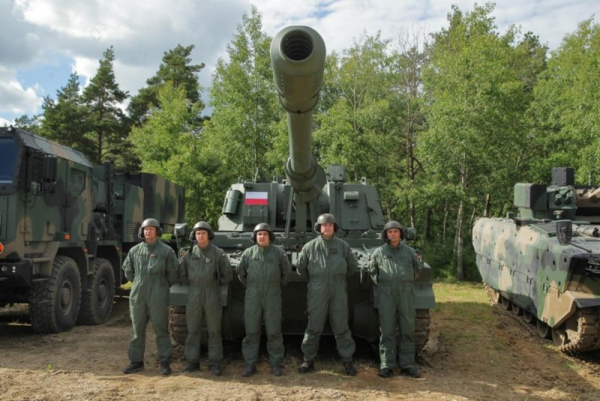
Soldiers taking part in military exercises codenamed ‘Brave Boar 26’ at the training ground in Orzysz in the Warmian-Masurian Voivodeship, Poland, 17 June 2026. Soldiers from the 16th Mechanized Division are taking part in the exercises and are training on new equipment, including Borsuk combat vehicles, K2 tanks and K9 howitzers. Photo by TOMASZ WASZCZUK / EPA
U.S. intelligence officials have warned Poland that Russia may be considering a limited military provocation against Polish territory in an effort to test NATO unity and disrupt Western support for Ukraine, according to recent reports.
The Telegraph and Polish outlet Onet reported Friday that Washington had shared intelligence with people close to Polish President Karol Nawrocki and senior officials at Poland’s Foreign Intelligence Agency about possible Russian scenarios targeting NATO’s eastern flank.
The reported plans could involve missile or drone strikes against critical infrastructure, a limited ground incursion from the Russian exclave of Kaliningrad or Belarus, or an operation designed to blur responsibility and delay NATO’s response.
The goal would not necessarily be a full-scale war, the reports said, but a political test of NATO’s Article 5 collective defense guarantee. Russia could attempt to portray a border crossing as an accident caused by GPS interference or as a rescue operation involving unmarked troops, often referred to as “little green men.”
Polish and NATO officials have been watching the region closely because Poland is a major route for Western military aid to Ukraine and sits near the Suwalki Gap, a narrow corridor between Kaliningrad and Belarus that is considered one of NATO’s most vulnerable points.
Against that backdrop, South Korean-made defense systems have become a key part of Poland’s front-line posture.
From June 16 to 26, Poland held Dzielny Dzik 26, or Brave Boar 26, at the Orzysz training area in northeastern Poland, about 70 kilometers from Kaliningrad. The exercise involved the Polish Army’s 16th Mechanized Division and allied forces, including troops from Lithuania and France.
The drills featured K2 Black Panther tanks, K9 Thunder self-propelled howitzers and FA-50 Fighting Eagle light combat aircraft, the three South Korean weapons systems Poland has acquired as part of a major defense modernization effort.
During the ground portion of the exercise, K2 tanks were used to test armored maneuvers across difficult terrain, while K9 howitzers provided rapid fire support from the rear. Asia Today reported that the artillery units were linked with fire-control systems to strike simulated enemy positions shortly after targets were identified.
The FA-50 aircraft were used for close air support missions, helping ground forces advance by striking simulated enemy positions. The aircraft also conducted combat air patrol missions near the Suwalki Gap and practiced responses to low-altitude threats such as drones.
The FA-50’s Link 16 tactical data link allowed the aircraft to share battlefield information with ground units and allied NATO assets, demonstrating compatibility with NATO systems.
The K9 howitzer network has also become an important part of deterrence on NATO’s northern and eastern flanks. Poland, Norway, Finland and other European users operate the same artillery platform or related supply chains, allowing them to coordinate logistics, maintenance and ammunition support more effectively.
For Poland, the South Korean systems are not only weapons purchases but part of a broader effort to field modern forces quickly as the threat from Russia grows. The K2, K9 and FA-50 give Warsaw armored, artillery and air support capabilities that can be deployed near the front line.
For South Korea, the deployments show how its defense industry has moved from export contracts to a more central role in European security.
As Russia’s war in Ukraine continues and concerns grow over possible hybrid operations against NATO territory, South Korean-made weapons are increasingly visible on the alliance’s eastern front.
— Reported by Asia Today; translated by UPI
© Asia Today. Unauthorized reproduction or redistribution prohibited.
Original Korean report: https://www.asiatoday.co.kr/kn/view.php?key=20260705010001560
