
Samsung Electronics, SK hynix boost Korean stock market.

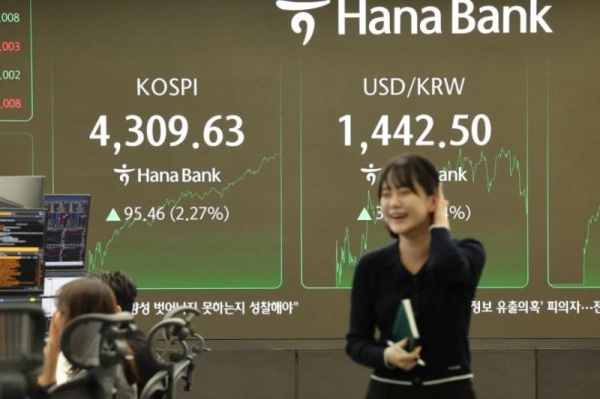
South Korea’s benchmark KOSPI reached a record high on Friday. The index is expected to remain strong this year, driven by the robust performance of the country’s semiconductor industry. Photo by Yonhap
South Korea’s benchmark KOSPI surged 75.63% last year, becoming the best-performing index among major economies, according to the state-backed Korea Exchange on Friday.
Since its introduction in 1983, the KOSPI has risen more than that annually only twice -92.62% in 1987 amid a highly favorable external environment like low crude oil prices, and 82.78% in 1999 when the Internet bubble drove share prices sharply higher.
Japan also cruised well in 2025, but its year-on-year gain was just above 26%. Major indexes in the United States, China, and Taiwan also posted gains, but they fell short of 25%.
Observers expect the KOSPI to remain strong this year, thanks to the solid outlook of the country’s key industries, including semiconductors and shipbuilding. The index climbed 2.27% on Friday to finish at a record high of 4,309.63.
“Led by semiconductor makers and shipbuilders, Korean exporters and growth companies are expected to underpin both the economy and the stock market in the years ahead,” Daishin Securities analyst Lee Kyoung-min told UPI.
“I expect that the KOSPI would appreciate by around 20% in the first half of the year to top 5,000 points. Later, the index could reach 5,300 points,” he said.
South Korea is home to the world’s top two memory chipmakers, Samsung Electronics and SK hynix, as well as such world-class shipbuilders as Hyundai Heavy Industries and Hanwha Ocean.
Samsung Electronics and SK hynix delivered stellar results throughout last year– each company is estimated to have posted more than $10 billion in operating profits during the fourth quarter.
As a result, the share price of Samsung Electronics more than doubled in 2025, while that of SK hynix nearly tripled.
The upside momentum is likely to persist. Samsung Electronics’ yearly bottom line is predicted to approach $70 billion in 2026. Nomura Securities forecasts that the figure could exceed $90 billion, far higher than its previous record of $41 billion in 2018. That of SK hynix is set to surpass $50 billion.
Against this backdrop, some brokerage houses, including NH Investment & Securities and HMC Securities, forecast that the KOSPI could reach 5,500 points in 2026.
“The KOSPI is highly likely to break above 5,000 points and sustain that level this year, with chipmakers playing the biggest role,” NH Investment analyst Kim Byung-youn said in a phone interview.
“Plus, artificial intelligence-friendly industries, including rechargeable batteries and automobiles, are expected to support the market. Brick-and-mortar sectors like construction are feared to struggle, though” he said.
Of note is that the KOSPI moved beyond 4,000 points for the first time last year. When President Lee Jae Myung took office June 4, the index stood below 2,700 points.
“When President Lee promised to jack up the KOSPI to 5,000 points by the end of his term in 2030, skepticism prevailed. Now, however, a majority of people appear to believe that the goal could be achieved soon,” Seoul-based business tracker Leaders Index CEO Park Ju-gun said.
Still, cautious voices remain, citing concerns about a potential AI bubble and volatile exchange rates.
“The Korean stock market has a single failure point because it relies so much on the semiconductor boom driven by the AI revolution,” said Lee Phil-sang, an adviser at Aju Research Institute of Corporate Management and former Seoul National University economics professor.
“If the so-called AI bubble bursts, our economy will face severe consequences, which will in turn weigh heavily on investor sentiment. The weak Korean won is another source of headache,” he added.
The Korean won remained weak throughout last year. In particular, the exchange rate neared 1,500 won per dollar late last year, before strengthening somewhat after the government signaled its readiness to intervene.
Mirae Asset Securities researcher Kim Seok-hwan concurred.
“A majority of our industries saw their exports decrease last year compared to 2024. But strong performance of semiconductors single-handedly carried the economy and stock market,” Kim said.
“Other sectors need to improve this year. Otherwise, it could be challenging for the KOSPI to reach 5,000 points,” he said.
According to the Ministry of Trade, Industry and Resources on Thursday, only six out of 15 major industries experienced declines in outbound shipments in 2025 from a year earlier.
Only two segments achieved double-digit growth — semiconductors at 22.2% and shipbuilding at 24.9%.
