
“Trust beyond business”: LS Electric Chairman Ja-Kyun Koo finds a global growth strategy in Utah


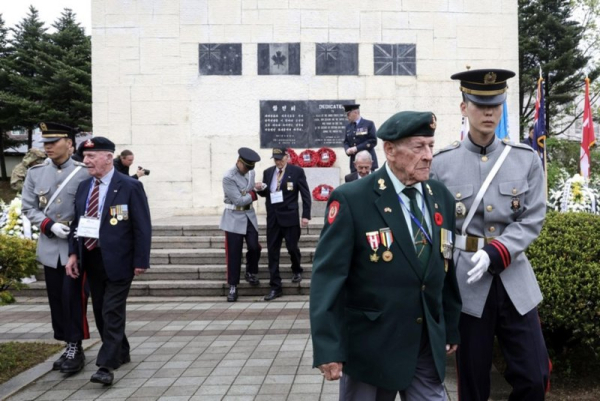
South Korean soldiers escort a group of Korean War veterans from Commonwealth nations during a ceremony marking the 73rd anniversary of the Battle of Kapyong, in Gapyeong County, northeast of Seoul, South Korea. The Battle of Kapyong, from 22 to 27 April 1951, was fought between United Nations Command forces composed mainly of Canadian, Australian, and New Zealand troops, and invading Chinese forces along the Gapyeong (Kapyong) River valley. Photo by YONHAP / EPA
South Korean power equipment maker LS Electric is strengthening its ties with communities in Utah by honoring Korean War veterans and investing in local education as it expands in the fast-growing North American power market.
Demand for power equipment has surged as artificial intelligence companies build more data centers across North America. Against that backdrop, LS Electric Chairman and Chief Executive Officer Ja-Kyun Koo has emphasized what the company describes as a management strategy based on long-term trust with local communities.
LS Electric said Koo has pursued the strategy through LS Electric Utah, formerly MCM Engineering II, in Cedar City. The South Korean company acquired the operation in 2022 and has since directed an expansion of its production facilities.
Koo has highlighted a Korean War engagement involving soldiers from southern Utah as a historical link between the state and South Korea.
On May 26, 1951, 240 members of the Utah National Guard’s 213th Armored Field Artillery Battalion encountered a Chinese force of more than 4,000 troops near Gapyeong in Gyeonggi Province.
The engagement became known in Utah as the “Miracle at Kapyong.” Accounts maintained by the Utah National Guard say the soldiers fought off the advancing force without losing a member of the unit in the battle.
Families and descendants of the veterans remain part of the community around Cedar City, where LS Electric Utah is based.
Koo said the soldiers’ service in an unfamiliar country demonstrated the kind of courage and commitment that a Korean company operating in Utah should recognize.
LS Electric this year sponsored a Southern Utah University program supporting Korean War veterans. The company also paid the travel expenses of surviving veterans who visited South Korea in May for a ceremony marking the 75th anniversary of the Utah unit’s action near Gapyeong.
The company has also supported the development of science, technology, engineering and mathematics education facilities at Southern Utah University as part of its efforts to train workers for the region’s future industries.
LS Electric joined a separate initiative led by the Korea Chamber of Commerce and Industry to connect Korean companies operating in the United States with veterans who previously served with U.S. Forces Korea.
The company said the program could help Korean businesses recruit workers who already have experience with South Korea and its culture.
LS Electric’s community engagement has accompanied a sharp increase in orders for equipment used in North American data centers.
Korea Investment & Securities said LS Electric secured two North American data center equipment projects during the second quarter with a combined value of 489.3 billion won, or about $318 million.
The brokerage expects the company’s North American data center orders to increase by more than 50% from a year earlier and surpass 1.5 trillion won, or about $974 million, in 2026.
“Today, our firm footing in the U.S. market rests on the noble sacrifice of Utah veterans who fought for freedom and peace,” Koo said.
“Remembering and honoring the heroes who created the Miracle at Kapyong is a responsibility that companies should fulfill,” he said.
Koo said businesses built on strong relationships with their communities would be better positioned to achieve stable, long-term growth.
— Reported by Asia Today; translated by UPI
© Asia Today. Unauthorized reproduction or redistribution prohibited.
Original Korean report: https://www.asiatoday.co.kr/kn/view.php?key=20260623010008080
