


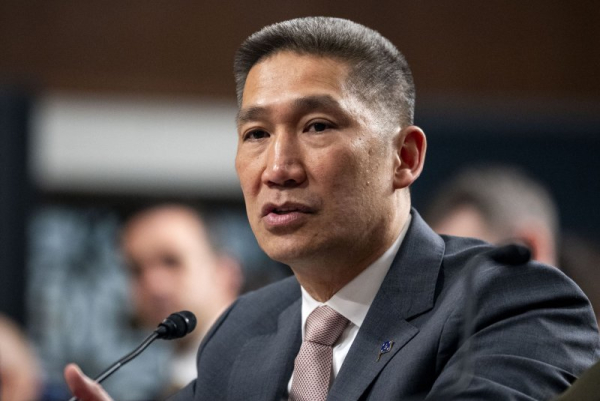
Acting Secretary of the Navy Hung Cao told the U.S. Senate Appropriations Defense Subcommittee that U.S. forces had the munitions needed for the conflict with Iran but a $14 billion arms sale to Taiwan was being put on hold just in case. Photo by Bonnie Cash/UPI | License Photo
The United States placed a $14 billion arms sale to Taiwan on hold to make sure the U.S. military has sufficient munitions stocks for the war with Iran.
Acting Navy Secretary Hung Cao told a U.S. Senate Appropriations defense subcommittee hearing Thursday that the pause was a precautionary measure and that the military still had “plenty” of missiles and interceptors.
“Right now we’re doing a pause in order to make sure we have the munitions we need for Epic Fury — which we have plenty. We’re just making sure we have everything, but then the foreign military sales will continue when the administration deems necessary,” he said, responding to a progress update query from the chairman of the panel, Sen. Mitch McConnell, R-Ky.
McConnell expressed concern when Cao said the final determination on the sale would be made by Defense Secretary Pete Hegseth and Secretary of State Marco Rubio.
“That’s what’s really distressing,” replied McConnell.
The deal received pre-approval from Congress in January, two months after an $11.1 billion sale was signed by U.S. President Donald Trump, but then stalled ahead of Trump’s May 13-15 state visit to China.
Three days after Hegseth told the same committee on May 12 that the availability of munitions was a non-issue, Trump said the arms deal could be “a very good negotiating chip” in dealing with China and that he would make a final determination on whether it would go through “over the next fairly short period of time.”
Beijing pressed Trump over Taiwan during his visit, urging the United States to exercise “extra caution” over support for the island, which China regards as a breakaway province, saying it could result in clashes and potential conflict that could place the entire Sino-U.S. relationship “in great jeopardy.”
A Taiwan government spokesman said Friday the administration was not aware of any change and had not been informed of “U.S. adjustments to the arms sale.”
The developments came two weeks to the day after Taiwan’s National Assembly passed a $25 billion defense budget and the island’s Democratic Progressive Party government continued to lobby Washington to keep the supply of arms flowing.
“If we want to prevent a war from happening, I think it’s best that Taiwan is strong, able to defend itself, and therefore we should be able to acquire — to buy the arms that we need to have a stronger defense, you know,” Taiwan representative to the United States Alexander Yui said earlier this week.
The special defense spending package, passed in the opposition-controlled legislature after a U.S. Senate delegation visited the island in March but was significantly smaller than the $40 billion President Lai Ching-te had been seeking in order to cover domestic weapons procurement, including unmanned aerial vehicles and sea drones, as well as the U.S. arms purchases.
The United States burned through much of its arsenal of seven key munitions types, including Tomahawk and Patriot missiles, in its five-and-a-half-week airborne offensive on Iran before the cease-fire kicked in on April 8, according to the Center for Strategic and International Studies.
CSIS said U.S. forces may have expended more than half of their prewar inventory of four types and that it would take one to four years to rebuild stocks across all seven munition types to prewar levels.
“These missiles will also be critical for a potential Western Pacific conflict. Even before the Iran war, stockpiles were deemed insufficient for a peer competitor fight. That shortfall is now even more acute, and building stockpiles to levels adequate for a war with China will take additional time,” said CSIS.
This week in Washington
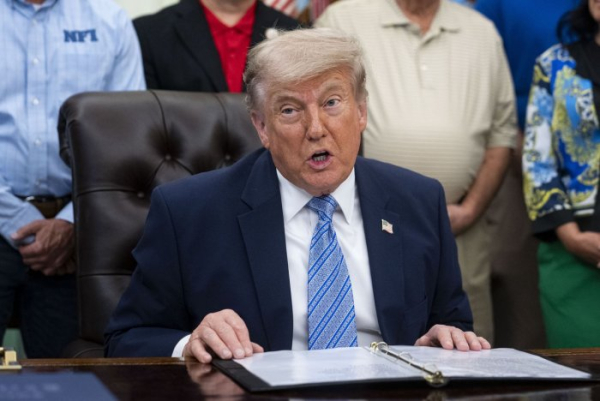
President Donald Trump speaks at an event with Environmental Protection Agency (EPA) Administrator Lee Zeldin in the Oval Office at the White House on Thursday. Photo by Al Drago/UPI | License Photo
