


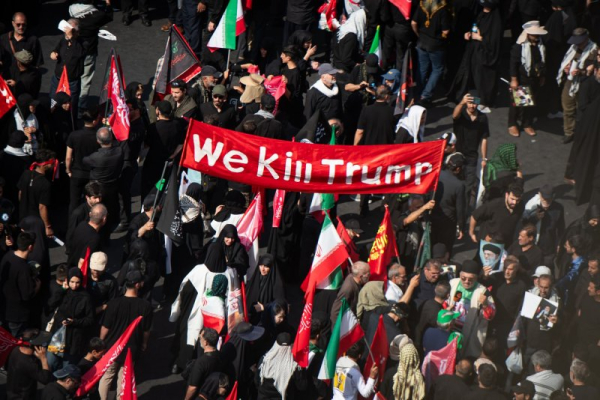
Mourners hold an anti-Trump poster as hundreds of thousands gather for the funeral procession of Iran’s late Supreme Leader Ali Khamenei, during a mass funeral march near Azadi Square in Tehran on Monday. Photo by Behnam Tofighi/UPI | License Photo
U.S. President Donald Trump said Wednesday that the cease-fire with Iran was no more after the sides traded hundreds of strikes overnight in an escalation that risked reigniting major military conflict in the region.
“I think it’s over,” Trump said in Ankara, Turkey, where he is attending NATO’s annual summit, after U.S. Central Command said it hit more than 80 targets in southern Iran in retaliation for Iranian attacks on ships attempting to transit the Hormuz Strait.
Tehran said it responded by targeting 85 U.S. military facilities in Bahrain and Kuwait.
Kuwait said it downed two Iranian ballistic missiles and 13 drones after they entered its airspace — but that there were no casualties.
Trump said the regime in Tehran was made up of duplicitous “sick” people and that it was pointless trying to reason with them.
“They’re scum. They’re sick people, and they’re vicious, violent people. Far as I’m concerned, it’s just a waste of time dealing with them. They’re liars,” said Trump who likened the leadership to a cancer that was best dealt with by being “cut out early.”
He also suggested he was top of Iran’s lists of people to take out and while he had been lucky so far, that might not last very long.
However, he stressed that while he was not prepared to waste any more of his time on “bad” actors, he would let his “wonderful negotiators keep talking,” if they wanted to, but that he no longer saw negotiation as the way forward.
Iran responded by demanding the United States recognize Tehran’s authority over the Strait of Hormuz.
“Recognize the new Iranian order in the Strait of Hormuz; this is the only way forward,” said Ebrahim Azizi, head of the Iranian parliament’s national security commission.
The developments sent oil prices sharply higher on fears renewed fighting would reverse the gradual resumption of energy shipments from oil and gas producers in the Persian Gulf that had been underway since Washington and Tehran agreed a 60-day cease-fire on June 17.
Brent crude, the global benchmark, jumped by $4.22 barrel, with the contract for September delivery trading at $78.38 in mid-afternoon trade in London on Wednesday. The contract for American crude for August delivery was changing hands for $74.28 a barrel, up $3.84.
Iran’s Armed Forces said in an earlier statement carried by state-run Islamic Republic of Iran Broadcasting that they had attacked 85 “key U.S. military installations” at Salman Port and the 5th Fleet, both in Bahrain, and Ali Al Salem Air Base in Kuwait.
The statement was followed by a second one announcing a “new wave” of missiles targeting U.S. bases in Bahrain.
The extent of the damage, if any, was not immediately clear, but the Kuwait Army confirmed in a statement that its air defenses were confronting “hostile missile and drone attacks.”
“We will not allow U.S. interference in the affairs of the Strait of Hormuz,” Khatam al-Anbiya Central Headquarters, Iran’s top military command body, said in a statement. “Transit through the SoH is only permitted via the routes designated by Iran.”
The strikes came hours after the U.S. military announced late Tuesday the completion of its attacks in Iran, a response to three commercial vessels being struck while transiting the Strait of Hormuz.
The maritime chokepoint has become a dangerous fault line in the war between the United States and Iran.
Washington is seeking to re-establish navigational freedom within the strait, while Iran is attempting to exert and maintain control of the waterway it has sought to exercise since the war began. Neither side appears to be budging, threatening the end of cease-fire negotiations and a return to all-out war.
Both sides accuse the other of violating conditions of the memorandum of understanding they agreed to implement last month to halt the fighting. Indirect negotiations held early this month in Doha produced little to no progress and the renewed fighting may upend the process altogether.
After three commercial vessels were recently struck while transiting the Strait of Hormuz, the U.S. military said it hit more than 80 targets inside Iran.
Before launching its retaliatory attacks early Wednesday, Khatam al-Anbiya Central Headquarters vowed in a statement carried by state-run Fars News Agency that it would “give a crushing response to America’s aggression and terrorist action.”
It said that “under no circumstances” would it allow U.S. interference in the affairs or management of the Strait of Hormuz.
