


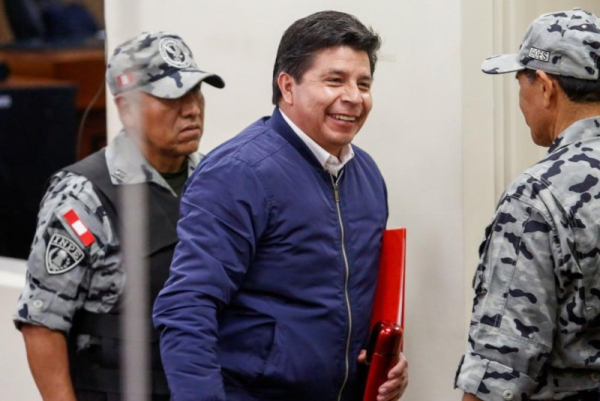
Former Peruvian President Pedro Castillo (C) attends a public hearing at the Special Criminal Chamber of the Supreme Court of Justice in Lima, Peru, in November 2025. The court sentenced Castillo to 11 years, five months, 15 days in prison for conspiracy to commit rebellion. File Photo by Renato Pajuelo/EPA
A United Nations panel has determined former Peruvian President Pedro Castillo’s detention is “arbitrary,” calling for his immediate release and compensation for violations of his fundamental rights under international treaties.
The U.N. Working Group on Arbitrary Detention said Peru failed to uphold key due process guarantees, questioned the legality of Castillo’s arrest after his failed attempt to dissolve Congress on Dec. 7, 2022, and cited the lack of a judicial warrant and the failure to respect presidential immunity.
According to the group’s opinion, Peruvian authorities violated Article 9 of the International Covenant on Civil and Political Rights, as well as Articles 3 and 9 of the Universal Declaration of Human Rights.
The report said Castillo’s arrest after his televised address announcing the dissolution of Congress, lacked a valid legal basis.
The experts argued there was no prior judicial warrant, and said the concept of being “caught in the act of committing a crime” did not exempt the state from respecting the immunity Castillo held as the sitting president.
The report also concluded that authorities improperly bypassed Peru’s constitutional impeachment procedure, which requires lifting a president’s immunity before an arrest can occur.
According to local media reports, the opinion triggered a political and legal debate over its potential implications for Peru’s institutions.
President José María Balcázar said Friday that the U.N. opinion could alter the legal and constitutional framework surrounding a possible pardon for Castillo.
“Pedro Castillo’s case will have to be analyzed in light of this new U.N. decision,” Balcázar said in an interview with Radio Nacional.
Balcázar previously expressed ideological sympathy for Castillo and even raised the possibility of granting him a pardon after he took office in February.
He later said the issue was “not on the agenda” because no formal request had been filed and legal requirements had not been met, though the U.N. opinion could change that assessment.
Former left-wing presidential candidate Roberto Sánchez called for Castillo’s immediate release in a post on X, writing that “the people’s freedom is breaking through.”
La verdad del Pueblo se abre paso@PedroCastilloTe ¡Libertad Inmediata! https://t.co/Ay0VJ7sEM9— Roberto Sánchez Palomino (@RobertoSanchP) July 10, 2026
By contrast, lawmakers and opposition leaders strongly rejected the U.N. findings.
Several members of Congress described the opinion as “ideological interference” and noted that Peru’s Supreme Court already sentenced Castillo to 11 years, five months, 15 days in prison for conspiracy to commit rebellion.
Critics argued that U.N. working group opinions are not legally binding on Peru’s domestic justice system.
However, Carlos Rivera, an attorney with the Legal Defense Institute, told La República that the working group’s opinions carry binding weight because Peru has ratified the international treaty that established the body.
Castillo’s legal team welcomed the opinion as a procedural victory, and said it would strengthen future petitions before the Inter-American Court of Human Rights. Peru has six months to formally respond to the U.N. working group’s findings.
Castillo has been held at Barbadillo Prison in the Lima district of Ate since December 2022. Authorities arrested him while allegedly committing a crime, and Peru’s Supreme Court later upheld the arrest in two separate rulings.
After his initial detention period expired, Peru’s judiciary ordered him held in pretrial detention for 18 months over the failed attempt to seize power. In December 2025, a special criminal court sentenced him to 11 years, five months in prison for conspiracy to commit rebellion.
