


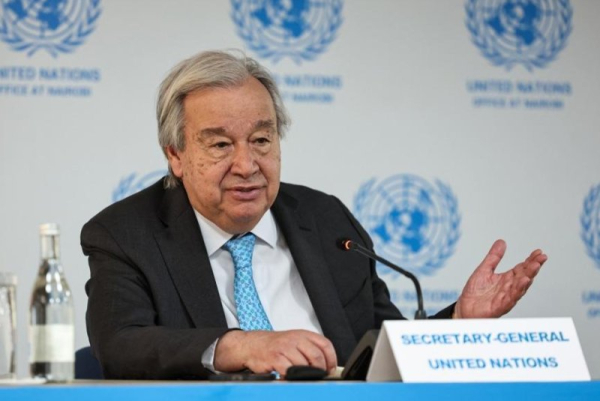
United Nations Secretary-General Antonio Guterres speaks during a press conference at the United Nations Office at Nairobi after a groundbreaking and office inauguration ceremony for a major expansion of the U.N.’s Nairobi headquarters in Kenya on Monday. Photo by Daniel Irungu/EPA
United Nations Secretary-General António Guterres said the U.S. capture of Venezuelan leader Nicolás Maduro came partially as a result of “major complicity” within his country’s power structure.
That statement prompted a formal protest from the government of interim President Delcy Rodríguez.
Speaking Monday at a news conference in Nairobi after a new U.N. office opened, Guterres said the Jan. 3 military operation in which Maduro was captured would not have been possible without fractures in loyalty inside Venezuela’s political system.
Asked whether a similar military intervention scenario could occur in Cuba, Guterres rejected the comparison, pointing to what he described as the erosion of trust within Venezuela’s ruling socialist movement, known as Chavismo.
“In Venezuela’s case, there was very significant complicity within the system itself that allowed what happened to occur,” Guterres said, suggesting the U.S. operation relied on key facilitators close to Maduro.
According to the U.N. chief, those fractured loyalties make Venezuela’s situation “completely different” from that of other countries in the region.
Despite referring to internal collaboration, Guterres maintained his criticism of the legality of the U.S. operation carried out by American special forces.
He reiterated that Maduro’s capture represents a “dangerous precedent” for state sovereignty and a clear violation of international law, warning of the long-term consequences of such interventions.
Venezuela’s government responded swiftly.
Foreign Minister Yván Gil issued a statement calling Guterres’ remarks “unworthy of his high office” and accused the U.N. secretary-general of acting in “bad faith” by promoting theories of internal betrayal.
In the statement, Venezuela’s Foreign Ministry said the comments lacked objectivity and prudence and reflected what it described as the “progressive deterioration” of the United Nations.
“The Venezuelan state expresses its firmest protest against these biased statements that seek to justify a criminal kidnapping and an attack on our sovereignty,” the statement said.
#Comunicado La República Bolivariana de Venezuela expresa su firme protesta ante las declaraciones, relativas al Estado venezolano, del Secretario General de la Organización de las Naciones Unidas, António Guterres, por considerar que contienen afirmaciones impropias de su… pic.twitter.com/akbfj5Zh0r— Yvan Gil (@yvangil) May 11, 2026
Gil reaffirmed the Venezuelan government’s position that the capture of Maduro and his wife, Cilia Flores, amounted to a kidnapping and criminal act carried out by the United States outside international law.
The foreign minister urged Guterres to return to “international legality” and respect Venezuela’s sovereignty, rejecting any suggestion of internal betrayal as a narrative used to justify foreign aggression.
Guterres’ remarks also renewed attention on media reports that have circulated since Maduro’s capture. International outlets including The Guardian have repeatedly pointed to senior Venezuelan officials, including Rodríguez, as possible participants in negotiations with Washington before the operation.
During the news conference, Guterres also rejected the possibility of a military solution for Cuba.
“There is no military solution that can be pursued” in Cuba, he said, calling for “meaningful dialogue to ensure that the Cuban people do not continue suffering as dramatically as they are today.”
