


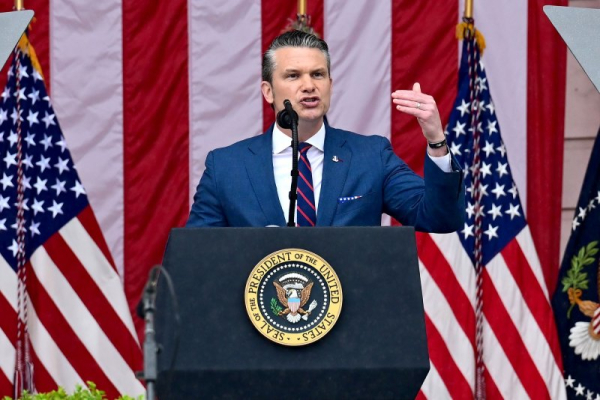
The U.S. military under Secretary of Defense Pete Hegseth attacked a suspected drug boat Wednesday in the eastern Pacific, killing two people. Photo by Kyle Mazza /UPI | License Photo
The U.S. military killed two men in a “lethal kinetic strike” of a suspected drug trafficking boat in the eastern Pacific on Wednesday, U.S. Southern Command said, its second fatal strike in two days.
Wednesday’s attack was the 59th of the monthslong anti-drug smuggling campaign, which now has a death toll of at least 196 people killed, though the status of two survivors from Tuesday’s strike was unknown. UPI has contacted the U.S. Coast Guard for comment on its search-and-rescue operation.
As with the previous strikes, little information was made public.
SOUTHCOM said in a statement that the vessel was “transiting along known narco-trafficking routes in the Eastern Pacific and was engaged in narco-trafficking operations.”
A 13-second black-and-white aerial video of the strike shows a boat stationary on the water before erupting in flames.
On May 27, at the direction of #SOUTHCOM commander Gen. Francis L. Donovan, Joint Task Force Southern Spear conducted a lethal kinetic strike on a vessel operated by Designated Terrorist Organizations. Intelligence confirmed the vessel was transiting along known narco-trafficking… pic.twitter.com/qKvSjxpk3P— U.S. Southern Command (@Southcom) May 28, 2026
The vessel, as with those previously attacked, was alleged by the U.S. military to have been operated by one of 10 drug cartels and gangs that President Donald Trump has designated as terrorist organizations since returning to the White House in January 2025.
The operation, known as Joint Task Force Southern Spear, uses the military to disrupt alleged narcotics trafficking but has attracted staunch opposition not only from Democrats, but also legal and human rights advocates, as well as the United Nations. At least one leader, Colombian President Gustavo Petro, has accused Trump of murder for killing a Colombian fisherman in an early strike.
Critics contends the strikes are unlawful extrajudicial killings because of the use of the military to execute ostensibly law-enforcement operations without charges being filed and tested in court.
Among the strongest-worded opposition has come from Ben Saul, the U.N.’s special rapporteur on counterterrorism and human rights, who described Trump’s war on narcoterrorism as “phoney” and called on the United States to address the root causes of the opioid epidemic by investing in vulnerable communities, education and social and public health measures. He also urged Washington to regulate U.S. military-grade weapons to stop them from flooding the Americas and arming cartels and destabilizing the region.
“These extrajudicial killings gravely violate the right to life, which applies extraterritorially,” he said in a mid-March report.
Trump has justified the use of the military by claiming the United States is in “armed conflict” with the drug cartels.
This week in Washington
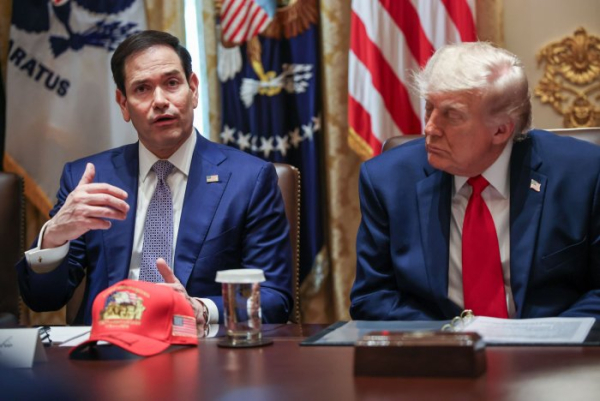
Secretary of State Marco Rubio and President Donald Trump participate in a Cabinet meeting in the Cabinet Room of the White House on Wednesday. Photo by Samuel Corum/UPI | License Photo
