

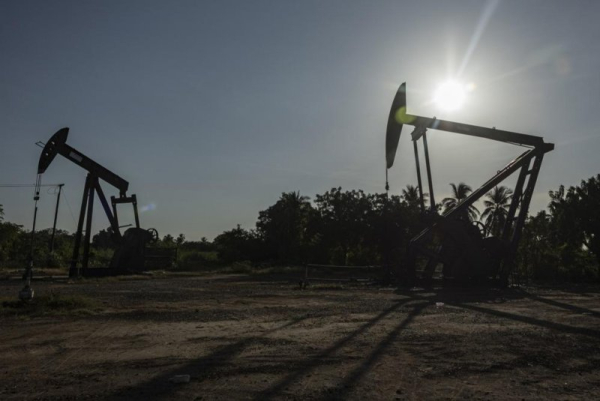
Experts say the reactivation of Venezuela’s oil sector faces an environment marked by high political uncertainty, deep structural constraints and institutional deterioration that cannot be resolved through investment or limited licenses alone. Photo by Henry Chirinos/EPA
President Donald Trump is betting on reactivating Venezuela’s oil industry within 18 months as a central pillar of his strategy toward the country, following the capture of former President Nicolas Maduro in an operation carried out by U.S. forces.
To that end, his administration is promoting agreements with U.S. companies to resume crude exports to the United States, while seeking to preserve internal stability in Venezuela and reduce the political and security risks that have deterred foreign investment.
Despite the optimism expressed in Washington, analysts and experts consulted by UPI agree that the reactivation of Venezuela’s oil sector faces an environment marked by high political uncertainty, deep structural constraints and institutional deterioration that cannot be resolved through investment or limited licenses alone.
Venezuela holds one of the world’s largest proven crude reserves and has low geological risk for oil production, a combination that for decades placed the country among the leading global energy producers. Today, however, the industry operates far from that past.
Venezuelan economist Antero Alvarado, director of Gas Energy Latin America Argentina, said the country is running on two different timelines. One is a long-term horizon filled with opportunity. The other is a short-term outlook dominated by politics.
“The big money is in the reserves, but that business takes time,” Alvarado said. In the near term, he added, quick results could include exporting stored crude, but sustained production growth remains a distant goal.
The main obstacle, he said, is risk perception. Major international oil companies remain reluctant to invest while a government without full international recognition remains in place and the institutional framework remains unstable.
For that reason, Alvarado sees it as more likely that medium-sized companies and regional firms will enter first, taking on the heavy lifting of the initial recovery.
Tomas Budinich, director of Energy and Resources at Deloitte Chile, agreed a wide gap exists between Venezuela’s potential and its current reality.
Venezuela today produces barely 1% of global supply, despite its vast resource base. Critical infrastructure, including pipelines, upgraders, refineries and terminals, is highly deteriorated — a problem compounded by the complexity of the heavy and extra heavy crude that dominates the Orinoco Belt.
“The challenge is greater because more than 70% of Venezuelan crude is heavy and extra heavy, which requires diluents, upgraders, high energy availability and an integrated logistics system that is now severely damaged,” Budinich said.
Investment estimates reflect that scale. Budinich and Patricio Jaramillo, director of Financial Risk at PwC Chile, agree that raising production to about 2 million barrels per day would require roughly $110 billion over seven to 10 years. The country currently produces about 1 million barrels a day, down from a peak of 3.5 million barrels a day during the 1990s.
Jaramillo added that returning to higher output levels would require as much as $200 billion and a full reconstruction of the entire oil chain — from exploration to refining and logistics.
For many analysts, however, politics is the true core of the problem.
Alberto Rojas, director of the Observatory of International Affairs at Chile’s Finis Terrae University, said the stability of Venezuela’s ruling structure will be decisive in attracting capital.
The recent reconfiguration of power after Maduro’s removal has left former Vice President Delcy Rodriguez leading the government and her brother, Jorge, heading the National Assembly, but with clear internal tensions.
Rojas warned that cohesion within the ruling movement remains fragile. Differences between the Rodriguez siblings and other power brokers, such as Diosdado Cabello and Vladimir Padrino, could lead to internal fractures that directly affect investment plans.
He also said the presence of armed civilian groups known as colectivos and parallel security structures create a climate of fear that inhibits economic activity and social expression.
“Washington is trying to avoid an internal collapse, but the current balance is precarious,” Rojas said.
He added that dismantling those armed groups and restoring effective territorial control are essential conditions for attracting long-term investment. Without that step, the risk that such groups evolve into paramilitary or criminal organizations remains real, with direct consequences for the energy sector.
“Disbanding them and confiscating their weapons will be indispensable for any normalization process, but that can only be done from political power, which implies complex negotiations within the regime itself,” he said.
Colombian economist Javier Mejia Cubillos, a lecturer at Stanford University in California, agreed that it is difficult to envision Venezuela’s oil sector prospering without a return to social and economic stability.
That does not necessarily imply a democratic transition, he said, but it does require “a reconfiguration of the state to make it more effective in providing public goods, especially security.”
From a broader perspective, Luis A. Pacheco, a former executive at Petróleos de Venezuela and currently a nonresident scholar at the Baker Institute at Rice University in Texas, said Venezuelan oil can be profitable even at current prices, but only if basic conditions are met.
“The recovery of the oil industry goes hand in hand with the recovery of the country,” Pacheco said, describing the process as a long-term task that far exceeds political timelines.
He cited territorial stability, reforms to the hydrocarbons law, legal certainty, access to technology and electricity, guarantees of physical security and modernization of the fiscal framework as essential requirements.
“Talking about 18 months is barely scratching the surface of Venezuela’s potential,” he said.
Venezuela has an advantage few countries share, Pacheco added, because the infrastructure exists, although damaged, and the reserves are in place.
“The global market still needs oil, especially heavy crudes like Venezuela’s,” he said. “But the country faces a dilemma because its greatest economic opportunity depends on resolving its deepest political and institutional weaknesses.”
Inside state oil company Petroleos de Venezuela, known as PDVSA, tensions remain high.
For decades, the company was synonymous with efficiency and international prestige. Years of mismanagement, corruption, sanctions, loss of skilled professionals and operational collapse have left weakened infrastructure and production.
According to what was described by Iván Freites, secretary for Professionals and Technicians at the Federation of Oil Workers of Venezuela, the current environment inside the company is one of “fragile normality.”
Operations continue due to worker commitment rather than management performance, he wrote on X. The Amuay, Cardon and Puerto La Cruz refineries process about 300,000 barrels per day, but face severe limitations, with projects stalled after foreign firms suspended activities amid uncertainty.
Freites warned that the departure of Iranian suppliers and the suspension of work by Chinese companies are warning signs.
Workers also face uncertainty over who will lead the company in this new phase. Recent history, including strikes, expropriations and sanctions, shows that every political shift has had a direct impact on the industry, Freites said.
