


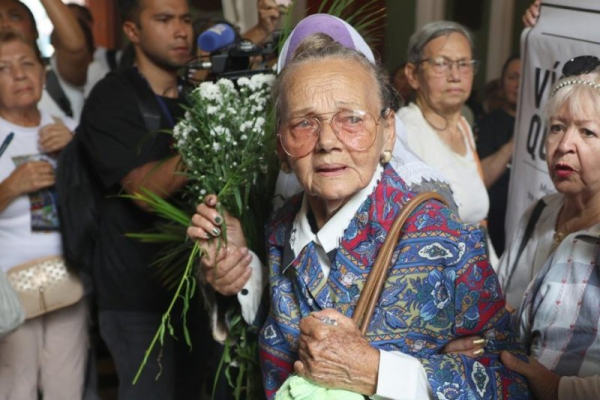
Carmen Navas, mother of Victor Hugo Quero Navas, attends mass in memory of her son in Caracas, Venezuela, on Friday, two days before her death. Venezuelan authorities confirmed Quero Navas died in state custody in July 2025, after his family had spent months seeking information about his whereabouts. Photo by Miguel Gutierrez/EPA
Carmen Teresa Navas, mother of Venezuelan political prisoner Víctor Hugo Quero Navas, died 10 days after authorities confirmed the death of her son while in Venezuelan state custody.
Her death Sunday followed months of complaints over his disappearance and the lack of information about his whereabouts.
Navas, affectionately known as the “grandmother of Venezuela,” became a national symbol of the struggle, suffering and dignity of the families of political prisoners in Venezuela, publicly exposing what human rights defenders and the opposition describe as the Venezuelan state’s “systematic cruelty” and institutional opacity.
Víctor Hugo Quero Navas, a 51-year-old businessman accused of terrorism, had been detained Jan. 3, 2025, and was being held at Rodeo I prison during a time when his family said it did not know his location, health condition or legal status.
For months, human rights organizations and relatives demanded proof that he was alive and sought access to official information about the detainee, while his mother traveled to prisons, courts and security agencies in Caracas to find answers.
“Give me proof of my son, where are they holding him? If he is alive … because since they arrested him, I have not seen him a single time,” Navas said May 4 at Altamira Square in Caracas during one of her final public appearances while holding a photograph of her son and defending his innocence.
The Ministry for Penitentiary Services confirmed Quero’s death in a statement released Wednesday. According to the document, Quero died July 24 at a military hospital in Caracas after suffering an “upper gastrointestinal hemorrhage and acute febrile syndrome.”
The ministry also said the cause of death was “acute respiratory failure secondary to pulmonary thromboembolism,” information that authorities said appears on the death certificate registered July 30.
That meant the state concealed the detainee’s death for nearly 10 months while the Ombudsman’s Office continued issuing false reports that the man remained alive in prison.
The Ministry for Penitentiary Services claimed that Quero “did not provide information about family ties” during his imprisonment and said no relatives formally requested visits.
Navas witnessed exhumation of her son’s remains. The body had been secretly buried in a mass grave without notifying the family.
In addition, the improvised gravestone showed discrepancies in the dates of death compared with the official statement, raising questions about the true circumstances of his death, the newspaper El País reported.
Scientific police exhumed the body Friday. That day, Quero was buried again in a different cemetery.
After confirmation of her son’s death, Navas publicly demanded DNA tests to verify the identity of the body and fully clarify the circumstances of the case.
Carmen Navas’ death was confirmed to CNN on Sunday by the person caring for her.
The non-governmental organization Foro Penal, which accompanied the family during its search for Quero, described Navas as a mother who was “tireless” in demanding truth and justice.
“Her strength, dignity and perseverance in the face of silence and uncertainty were an example of the strength of mothers and relatives of victims in Venezuela,” the organization said in a statement posted on Instagram.
Venezuelan authorities said a criminal investigation had been opened to determine the causes of death. The Attorney General’s Office said it would carry out proceedings to clarify the facts, while the Ombudsman’s Office called for a review of possible responsibilities and guarantees of due process.
Human Rights Watch and Amnesty International have described the actions of Venezuela as a campaign of systematic, widespread and brutal repression.
After the dramatic political changes that occurred at the beginning of 2026, including the capture of Nicolás Maduro by U.S. forces and establishment of an interim government led by Delcy Rodríguez, the organizations warned that the state’s repressive apparatus remains completely intact.
According to reports by EVTV, students at the Central University of Venezuela blocked access to the Francisco Fajardo highway Monday to demand justice for the deaths of Quero and his mother, as well as an end to political persecution in the country.
