


China recovered a reusable rocket booster for the first time in its history on Friday, marking a milestone for the country’s space program.
It was the maiden flight for the Long March-10B, a two-stage rocket about 207 feet tall, as it delivered a satellite into orbit.
After separating from its second stage, the rocket began a 6-minute return journey and was captured by a net on a seaborne platform.
“Net-based recovery simplifies the onboard structure, reduces weight and boosts payload capacity,” Chen Muye, of the China Aerospace Science and Technology Corporation, told Xinhua News Agency.
“It also demonstrates strong adaptability to landing deviations, effectively ‘enlarging’ the capture window through coordinated net operations,” he added.
The breakthrough brings Chinese aerospace development on par with Elon Musk’s SpaceX and Jezz Bezos’ BlueOrigin, both of which have been recovering rockets since 2015.
Reusing boosters significantly reduces the cost of spacebound missions, as stage-one rockets are the most expensive segment of the spacecraft.
National Air and Space Museum celebrates 50th anniversary
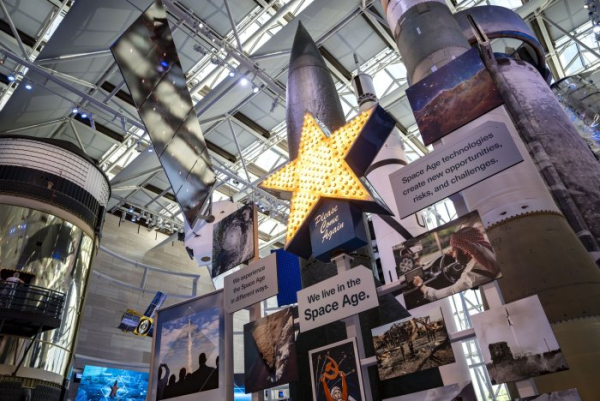
The newly renovated “Living in the Space Age” exhibit it seen at the Smithsonian’s National Air and Space Museum on the National Mall in Washington on July 1, 2026. Photo by Bonnie Cash/UPI | License Photo
