


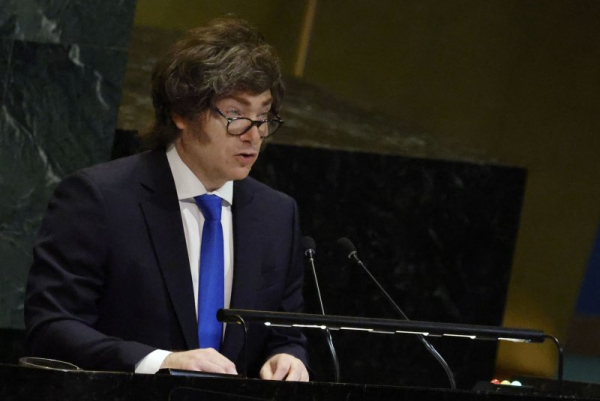
The World Bank’s board approved a $2 billion financial guarantee package for Argentina. File Photo by Peter Foley/UPI | License Photo
The World Bank’s board approved a $2 billion financial guarantee package for Argentina, a move aimed at helping the country meet upcoming foreign currency debt obligations and support its return to international credit markets.
The package is not a traditional cash loan. Instead, it consists of credit guarantees provided through two World Bank institutions, the International Bank for Reconstruction and Development and the Multilateral Investment Guarantee Agency, which will cover nearly all of the risk assumed by private lenders.
“We are committed to supporting Argentina’s macroeconomic stabilization and its growth-oriented reform agenda,” Susana Cordeiro Guerra, the World Bank’s vice president for Latin America and the Caribbean, said Tuesday.
The guarantees are expected to unlock approximately $4 billion in financing from international banks, including JPMorgan, according to Argentine newspaper Clarín.
With the World Bank’s backing, interest rates on the new loans are expected to range between 5.5% and 6.5% annually, significantly below the 9% to 10% rates Argentina would likely face without guarantees. The loans are expected to carry six-year maturities and three-year grace periods.
According to Argentine news outlet Infobae, the guarantees will support efforts to mobilize private investment in infrastructure, strengthen market competition and improve the business environment for companies of different sizes.
Argentina’s economic team, led by Economy Minister Luis Caputo, is seeking to secure additional liquidity before July 9, when approximately $4.3 billion in payments to private bondholders come due.
The multilateral guarantee structure is intended to reduce pressure on the Central Bank’s reserves as Argentina faces roughly $7 billion in debt obligations this year. As of last week, the Treasury held $2.917 billion in foreign currency assets, equivalent to about 66% of the July 9 payment requirement, according to Ámbito Financiero.
The financing strategy also involves support from other multilateral lenders. The Inter-American Development Bank was expected to consider a separate $550 million guarantee for Argentina on Wednesday. By the end of July, the Development Bank of Latin America and the Caribbean, known as CAF, is expected to discuss an additional $500 million support package.
Argentina continues to rely on such guarantees because international financial markets remain cautious about its creditworthiness and demand relatively high borrowing costs due to the country’s long history of macroeconomic instability and repeated sovereign debt defaults.
The country has defaulted on its debt nine times in its modern history, contributing to a reputation among investors as a serial defaulter. That perception has been reinforced by recurring shortages of foreign currency reserves, high inflation and a long-standing pattern of fiscal deficits that have often required external financial assistance.
Although the administration of President Javier Milei has eased short-term concerns through fiscal austerity measures and a sharp decline in Argentina’s country risk indicator to its lowest level in eight years, global investors remain cautious and continue to seek additional safeguards before extending unsecured financing, concerned that past political and economic imbalances could reemerge.
