

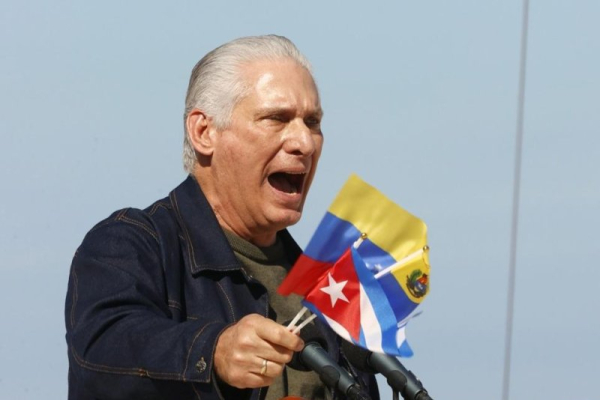
Cuban President Miguel Diaz-Canel’s government has engaged in a higher level of repression, according to Amnesty International. Photo by Ernesto Mastrascusa/EPA
Amnesty International reported what it describes as an escalation of arbitrary detentions, illegal surveillance and harassment targeting relatives of political prisoners and people linked to high-profile cases of state repression in Cuba, according to a statement released Tuesday.
The human rights organization said it verified information about state security operations that include police blockades around homes, constant surveillance, restrictions on freedom of movement and threats against activists and government critics.
“The constant surveillance of homes, short-term arbitrary detentions and unjustified restrictions on leaving one’s home are part of a systematic pattern of authoritarian practices the Cuban state is using to punish and deter any form of dissent,” said Johanna Cilano, Amnesty International’s Caribbean researcher.
Amnesty International said the growing harassment and deterioration in the health of detainees point to a persistent pattern of repression and authoritarian practices.
One of the most prominent recent cases involved the detention of Ernesto Ricardo Medina and Kamil Zayas, two young influencers from the audiovisual project “El 4tico.” Both were detained Friday after a police search at their home.
Armando Labrador, of opposition platform Cuba Primero, said the two had faced harassment, surveillance and criminalization by state security authorities because of civic activism and criticism of the government.
Labrador also reported an increase in protest graffiti and posters against the government led by President Miguel Díaz-Canel appearing overnight in several cities.
According to the activist, slogans such as “Viva Trump,” translated as “Long live Trump,” and “Cuba 1ro,” or “Cuba First,” were painted on educational centers, public areas, sports facilities and locations near government buildings, highlighting the visibility of the actions.
Independent media outlet Diario de Cuba reported that the spread of anti-government messages reflects growing social dissatisfaction and continued attempts by citizens to express dissent despite risks of reprisals.
Messages cited included “The people want Canel’s downfall,” “Maduro has fallen, Canel will fall soon,” “Down with the Castros” and “The people thank the United States for its support,” reportedly seen in parts of Havana.
Authorities typically remove such messages quickly and do not officially report the incidents, but independent organizations and activists say responses often include interrogation, temporary detention and surveillance of suspected individuals.
A Cubadata study of Cuban citizens published in November by a Peruvian university found declining public confidence in the country’s political system. The research showed 81.9% of respondents expressed skepticism toward the Communist Party and 77% rejected the government’s economic management.
The study said only 4.7% considered the Cuban government effective, while 26.4% rated it bad and 25.1% very bad. It also reported 40.7% said their opinion of the government had significantly worsened over the past year and 71.5% believed authorities frequently restrict freedom of expression.
Moreover, 58.2% of respondents said the government uses repressive tactics to maintain political control. Cubadata said dissent often appears in everyday practices such as political humor, reinterpretation of official language, private entrepreneurship and expressions of solidarity with political prisoners.
