

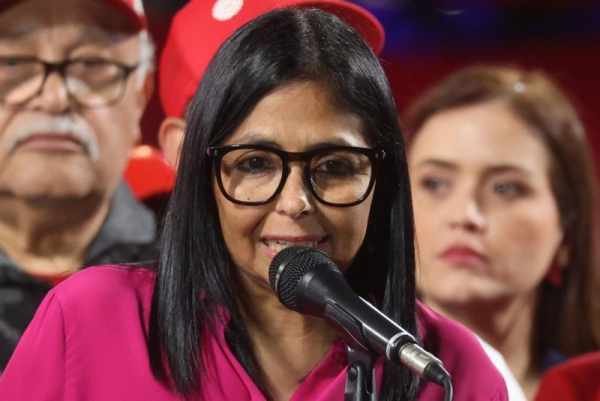
Venezuela’s interim president, Delcy Rodriguez, does not plan to hold elections in the near future, said her brother, Jorge, president of the National Assembly, Photo by Jorge Rodríguez/EPA
Venezuela will not hold elections in the short term, National Assembly President Jorge Rodríguez said, amid growing political tension marked by the release of opposition leader Juan Pablo Guanipa, his abduction less than 12 hours later and his transfer to house arrest in the city of Maracaibo.
Jorge Rodríguez, brother of interim President Delcy Rodríguez, ruled out the possibility of immediate elections and said the country must first go through a process of “stabilization” after the capture of President Nicolás Maduro by the United States.
“The only thing I can say is that there will be no elections in this immediate period in which stabilization must be achieved,” Jorge Rodriguez said in an interview with the Newsmax network Saturday that was broadcast Monday.
President of the National Assembly, he said said the interim government is working on what he called the “re-institutionalization of the country,” with the goal that all institutions “regain their full functioning and recognition by all.”
In that context, he said authorities will move toward “a timeline that works for everyone and that guarantees not only the winners, but also the losers, that all guarantees will be safeguarded.”
Asked about the illegitimacy of the July 2024 presidential elections in which Nicolás Maduro was declared the winner despite allegations by the opposition and much of the international community, Rodríguez rejected the possibility of fraud and said that “in Venezuela we have a very clear itinerary, a very well-defined electoral schedule, and this is clearly established in the Constitution.”
Rodríguez’s statements contrast with those of opposition leader María Corina Machado, who said days earlier that “transparent” elections could be held within nine or 10 months. She clarified that she has not spoken with U.S. President Donald Trump about a specific timetable.
From Washington, Machado questioned the lack of a clear electoral schedule and said that recent repressive episodes, such as the Guanipa case, cast doubt on the regime’s willingness to move toward a credible political process.
The debate over the country’s electoral future is unfolding in parallel with the case of former lawmaker Juan Pablo Guanipa.
The opposition leader was released Sunday after spending 261 days in pretrial detention. Less than 12 hours later, on Sunday night, he was intercepted in Caracas by armed men in civilian clothing, without identification or a court order, according to his family.
His son, Ramón Guanipa, denounced the incident as a kidnapping.
“He was intercepted by armed men, without uniforms and without identification, and no court order was presented,” he said, while demanding guarantees for his physical integrity.
The Public Prosecutor’s Office later reported that it had requested the revocation of the release order for an alleged failure to comply with the conditions imposed after his release.
Interior Minister Diosdado Cabello publicly defended the regime’s actions and said the new detention occurred due to violations of those conditions.
“Some politicians believed they can do whatever they want and stir up chaos in the country by violating the very conditions under which they are being granted freedom,” Cabello said during his weekly press conference as secretary general of the United Socialist Party of Venezuela.
The Attorney General’s Office said Guanipa failed to comply with obligations such as periodic court appearances and the prohibition on leaving the country, and asked the competent court to change the precautionary measure.
In the early hours of Tuesday, the opposition leader was transferred from the headquarters of the Bolivarian National Police in Maripérez, Caracas, to the domestic airport in Maiquetía and then to his residence in Maracaibo, where he remains under house arrest, with surveillance and movement restrictions.
Press reports said Guanipa’s transfer to house arrest took place amid pressure from U.S. officials, including Secretary of State Marco Rubio and Florida Sen. Rick Scott.
Machado condemned the regime’s actions and said the Guanipa episode shows that the releases announced by the chavista government do not guarantee the full exercise of political and civil rights.
According to the opposition leader, 644 people remain detained in Venezuela for political reasons, in a context that, she warned, reflects a sustained pattern of human rights violations.
