

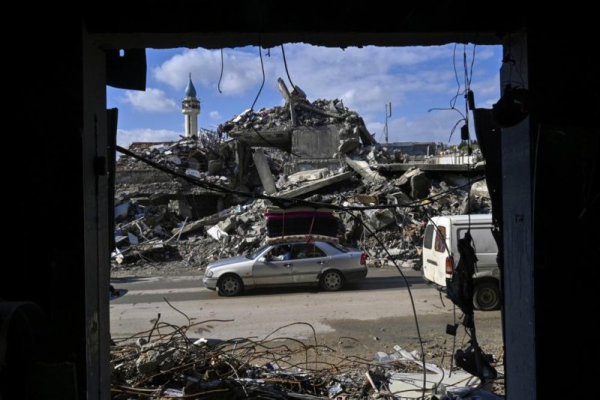
Displaced residents return to Nabatieh in southern Lebanon after a cease-fire deal between Israel and Hezbollah on November 28, 2024. File Photo by Wael Hamzeh/EPA
Lebanon remains locked in a vicious cycle since last year’s cease-fire accord that never truly ended the war, facing an unrestrained Israel imposing its own terms and ignoring calls for negotiations.
Meanwhile the United States is applying pressure solely on Beirut and Hezbollah that resists disarmament and funding cuts to preserve its own survival.
Unless the United States and eventually Israel change their current strategy, the likely outcome would be a broader escalation — another round of destructive war — and ultimately the breakdown of Lebanon, political analysts and risk strategists warn.
For a year now, since the Nov. 27, 2024, truce agreement, Israel has acted with near-total freedom, striking suspected Hezbollah operatives and positions almost daily, causing further destruction and casualties, even though this also leads to killing civilians.
The Iran-backed group, which was severely weakened during the war that erupted when it opened a support front for Gaza on Oct. 8, 2023, kept a low profile and refrained from retaliating, instead quietly attempting to reorganize its ranks and secure new channels for rearming and refunding.
Lebanon’s successful efforts to disarm Hezbollah and eliminate its military presence along the border and south of the Litani River were never reciprocated by Israel or Washington.
Instead, both increased their pressure on Beirut, turning a deaf ear to its demands that Israel — even gradually — withdraw from five strategic positions it still occupies in southern Lebanon, release Lebanese prisoners detained during the war, allow displaced residents to return to their border villages and permit reconstruction.
The cease-fire proved to be “one-sided” since last November, according to Mohanad Hage Ali, an analyst and fellow at the Beirut-based Carnegie Middle East Center.
Hage Ali said Israel’s use of its “freedom of action” and its continued occupation of Lebanese territory are putting the Lebanese government in an increasingly weak position,
“Weakening the only government Lebanon has had since the end of the [1975-90] civil war — one that is actually working seriously toward disarming an organization fighting Israel and eliminating any security threat to it — doesn’t make sense … if Israel is truly seeking stability,” he told UPI.
With the U.N. peacekeeping force in south Lebanon recently confirming that Israel has built concrete walls that cross the U.N.-drawn Blue Line into Lebanese territory, Hage Ali said it appears that Israel has “long-term territorial ambitions” in Lebanon similar to those it has in Syria.
He said that negotiations between Israel and Syria over security arrangements have so far failed, and it is “highly unlikely” that any Lebanese-Israeli negotiations would succeed.
To Israel, the ongoing escalation and its freedom of action now offer “great benefits for its strategies” and are unlikely to be abandoned to pave the way for negotiations anytime soon, Hage Ali said.
However, no change can be expected unless the United States, which is currently focused on ending the Ukraine-Russia war and finalizing the Gaza deal, exerts significant pressure on Israel, he said.
For Hezbollah, the war has not stopped and the conflict with Israel continues.
“It is a battle where sometimes the enemy succeeds and other times fails,” said Kassem Kassir, a political analyst who specializes in Islamic movements and is close to Hezbollah.
Kassir argued that the militant group, was trying to reorganize, protect itself and, most importantly, safeguard its “very existence.”
“This [existence] is the most important goal, and Hezbollah has succeeded in achieving it over the past year, enabling it to face all challenges,” he told UPI. “We need to be ready for all possibilities while keeping the door open for negotiations and working to close the [group’s] gaps.”
One of Hezbollah’s biggest challenges, however, appears to be the increasing sanctions and efforts by the United States to curb its funding sources, which have been putting the Lebanese government under tremendous pressure to act.
Washington’s main targets include Iranian financial support, Hezbollah’s internal financial networks, such as Al-Qard al-Hassan, and the group’s global illicit revenue streams.
According to Mohammad Fheili, a risk strategist and monetary economist, financial pressure has already bitten into Hezbollah’s margins, with its cash liquidity in “clean” dollars becoming tighter, salaries and benefits for fighters and some cadres reportedly cut or delayed, and certain external operations and procurement activities becoming more expensive and slower to execute.
“At the same time, Hezbollah has adapted by shifting further toward cash, gold, informal value-transfer mechanisms and in-kind support from Iran, while embedding itself even more deeply in Lebanon’s cash economy, where state capacity and oversight are weakest,” Fheili told UPI.
He noted that additional pressure can still have meaningful effects, but within “a realistic ceiling,” while tougher measures can “increase friction and cost by forcing Hezbollah to use more intermediaries, accept higher risk premia and rely on more complex routing of funds.”
The group, he said, will continue to find room to maneuver, having demonstrated in the past a “remarkable capacity” to adapt its financial methods — shifting from using banks to relying on money exchangers, cash and hawala networks, as well as operating through front entities and charities and leveraging regional and diaspora networks in trade, construction and services.
“That adaptability remains intact,” Fheili noted, but financial pressure can restrict its activities and reduce its ability to sustain pre-crisis levels of social services, reconstruction projects and welfare payments that have “historically underpinned its local legitimacy.”
Lebanon is slowly adopting measures and issuing laws as part of its efforts to combat money laundering and the financing of terrorism, without provoking a severe reaction from Hezbollah — at least for now.
Hezbollah presently has limited influence over the Beirut port and airport — previously used to smuggle money and weapons — forcing it to rely on passengers to carry cash from different destinations after the Lebanese government stopped all direct flights from Iran.
Such a change comes at a rising cost for Hezbollah, forcing it to “lean more on informal and risky channels”, Fheili said.
With mounting pressures and heavy casualties, Hezbollah will need to reestablish some form of deterrence with Israel and rejoin the fight, according to Hage Ali.
While the Lebanese government seems unable to move forward, he said, the United States and Israel do not appear to be achieving their objectives with their current strategy.
“This will lead to the breakdown of Lebanon,” he warned. “I hope this strategy can shift in a positive way, for the benefit of everyone, and to avoid another round of violence.”
