

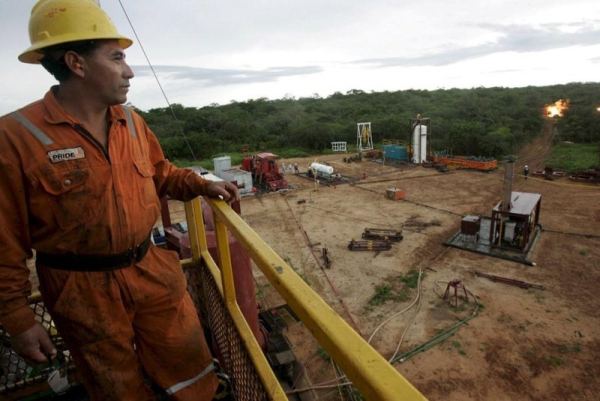
The draft of a new Bolivian hydrocarbons law prioritizes the reactivation of mature fields and traditional wells to maximize recovery of remaining reserves. File Photo by Martin Alipaz/EPA
The government of Rodrigo Paz has finalized the draft of a new hydrocarbons law, marking a key reform aimed at reviving energy investment and steering Bolivia’s energy sector toward bolstering natural gas and oil production.
Hydrocarbons Minister Mauricio Medinaceli told local media the main goal of the legislation is to attract foreign investment. The proposal outlines five core pillars to reposition Bolivia as an energy-producing nation rather than a net importer.
The draft seeks to introduce more competitive conditions to draw capital, strengthen legal certainty and ease some contractual terms while maintaining state control over natural resources, according to the Bolivian newspaper El Deber.
“Bolivia is undergoing a structural shift because there will be a new hydrocarbons law, and we will present it as a national agreement among Bolivians,” Paz said earlier this week during a visit to Brazil.
“That law will not benefit the state alone. It will benefit the development capacity of Bolivians across all regions.”
Authorities said the framework is designed around competitiveness and legal security, aiming to establish conditions that allow immediate foreign investment inflows, local broadcaster Red Uno reported.
To that end, the proposal includes fiscal and contractual incentives intended to make Bolivia more attractive to international operators. It prioritizes the reactivation of mature fields and traditional wells to maximize recovery of remaining reserves.
On the operational side, the law calls for a deep overhaul of contracting mechanisms to make them more agile and transparent, reducing bureaucratic bottlenecks.
At the same time, the government plans to strengthen the role of state-owned Yacimientos Petrolíferos Fiscales Bolivianos as the central player in the production chain, with the aim of reducing costly fuel imports.
Officials said the reform also seeks to ensure stable domestic supply following a 2025 fuel shortage crisis marked by recurring diesel and gasoline scarcities, long lines at service stations and protests by transport workers.
Bolivia’s hydrocarbons sector experienced a “golden era” between 2006 and 2014, driven by high global prices and peak production levels. That cycle later weakened due to natural depletion of reserves and limited exploration investment during years of rule by the Movement for Socialism.
Official data and industry sources show that investment in exploration and production, which exceeded $1 billion annually in the past decade, has steadily declined to below $500 million.
Natural gas output, the country’s main export, has dropped from more than 60 million cubic meters per day at its peak to about 40 million cubic meters or less per day, affecting Bolivia’s ability to meet export commitments with Brazil and Argentina.
