


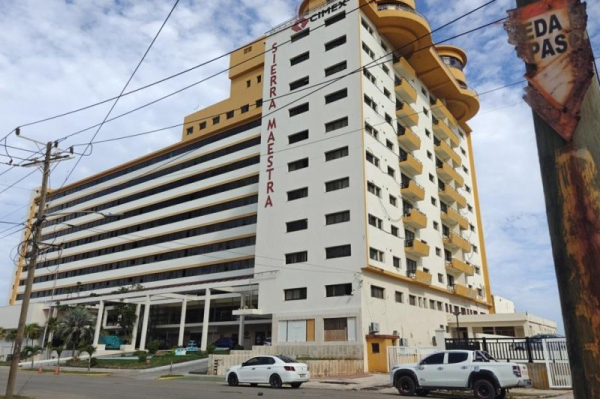
The facade of the CIMEX building, a conglomerate that belongs to the military-run business conglomerate GAESA, in Havana on Tuesday. The Cuban government denied that GAESA is an “opaque structure” that operates ‘parallel to the state’ in its first statement on the matter since the entity was sanctioned by the United States a month ago. Photo by Juan Palop/EPA
Asian hotel chain Archipelago International has ended its operations in Cuba under the Aston brand, becoming the third international operator to leave the island in less than a week.
The decision comes ahead of new U.S. sanctions that are to take effect against GAESA, the business conglomerate run by Cuba’s Armed Forces.
Under the Aston brand, Archipelago managed several hotels belonging to Gaviota Tourism Group, Cuba’s leading tourism company and one of the firms that make up Grupo de Administración Empresarial S.A., known as GAESA.
They include Grand Aston Havana, Grand Aston Varadero, Grand Aston Cayo Paredón, Grand Aston Cayo Las Brujas and Aston Costa Verde.
The departure was reported Monday by Reportur.us and follows the recent exits of other major hotel operators, including Canada’s Blue Diamond and Spain’s Iberostar, which also reduced or ended operations linked to Gaviota.
The moves come just days before the Friday deadline set by Washington for foreign companies to end business dealings with entities controlled by GAESA or face potential sanctions.
The departures are taking place amid a deep crisis in Cuba’s tourism sector, brought about largely by the U.S. blockade. According to official figures cited by Directorio Cubano, visitor arrivals fell 56% during the first four months of 2026.
The decline in tourism already affected some hotels operated by Aston before the withdrawal announcement. Workers told Cuban digital outlet 14ymedio they were sometimes instructed not to report to work because of a lack of guests.
Washington announced new measures last month against GAESA and several of its subsidiaries, warning that foreign companies maintaining commercial ties with the conglomerate could face financial restrictions and secondary sanctions.
In response, President Miguel Díaz-Canel published a public defense of GAESA on Tuesday in a statement distributed by the state-run newspaper Granma.
The Cuban government rejected U.S. accusations against the conglomerate and argued that it has been a key tool in sustaining the national economy since the Special Period crisis of the 1990s.
“The GAE is not the product of secrecy, nor of elites, and much less a vehicle for the enrichment of a few,” Díaz-Canel wrote on social media platform X.
“It is one of many examples that throughout our journey has allowed us to withstand the permanent aggression of the United States government.”
Declaración del Gobierno Revolucionario:
El GAE no es obra del secretismo, ni de élites y mucho menos la vía de enriquecimiento de unos pocos. Es, por el contrario, uno de los tantos ejemplos que a lo largo de nuestro camino nos ha permitido resistir la agresión permanente del…— Miguel Díaz-Canel Bermúdez (@DiazCanelB) June 2, 2026
His statement said GAESA helped finance housing, infrastructure, healthcare and education projects, and it contended that the sanctions are part of a U.S. strategy aimed at economically and financially isolating Cuba.
Attention is now focused on other companies with a presence on the island, particularly Spain’s Meliá, the largest foreign hotel chain in Cuba, which manages more than 14,000 rooms in the country and maintains agreements with hotels linked to Gaviota.
Meliá has cut its operations in half after reporting a 68% drop in annual profits, Diario de Cuba reported.
Although the chain has not announced changes to its operations in Cuba, its chief executive officer, Gabriel Escarrer, recently acknowledged that the situation on the island is “hard” and “unsustainable,” and that the company has had to concentrate tourists in a smaller number of hotels because of falling demand, according to reports by UltimaHora.es.
