


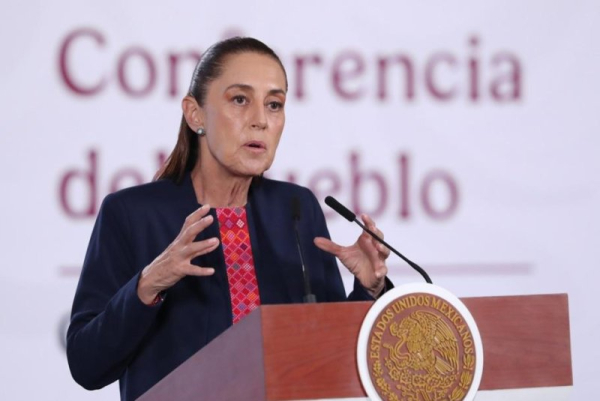
Mexican President Claudia Sheinbaum urged U.S. Ambassador Ronald Johnson on Tuedday to focus strictly on the bilateral agenda and refrain from commenting on Mexico’s domestic political affairs. Photo by Mario Guzman/EPA
Mexican President Claudia Sheinbaum publicly urged U.S. Ambassador Ronald Johnson on Tuesday to focus strictly on the bilateral agenda and refrain from commenting on Mexico’s domestic political affairs.
“Mexico’s affairs belong to Mexicans,” Sheinbaum said during her morning news conference, referring to recent remarks posted by the U.S. ambassador on social media.
Johnson had called for an end to the politicization of the fight against organized crime, arguing that political disputes undermine efforts to strengthen shared border security.
“The fight against cartels should unite us, not divide us,” Johnson wrote. “People on both sides of our border want to live safely and in peace. They deserve freedom from the intimidation, corruption and fear that the cartels inflict.”
The fight against cartels should unite us, not divide us. People on both sides of our border want to live safely and in peace. They deserve freedom from the intimidation, corruption, and fear that the cartels inflict. Every moment spent turning this shared security challenge…— Embajador Ronald Johnson (@USAmbMex) June 1, 2026
Sheinbaum said ambassadors should limit their activities to coordination and bilateral cooperation and avoid involvement in the internal political affairs of the countries where they are accredited.
The ambassador’s message came after an event led by Sheinbaum on Sunday at Mexico City’s Monument to the Revolution, where she defended national sovereignty and criticized what she described as U.S. actions that constitute interference in Mexico’s internal affairs.
On Monday, Sheinbaum went further, alleging that far-right groups in the United States were coordinating with domestic organizations to attack her administration and escalating her criticism of Washington.
Citing Mexico’s constitutional principles of nonintervention and self-determination, Sheinbaum argued that Mexican diplomats abroad do not comment on the domestic politics of other countries and called for the same level of reciprocity.
She acknowledged that violence linked to organized crime is a shared challenge, and restated Mexico’s willingness to cooperate with the United States on security matters and efforts to combat criminal organizations.
“We seek collaboration and coordination so that we can move forward together. They should act in their territory and we will act in ours,” Sheinbaum said.
The dispute follows a political crisis triggered in late April when the U.S. Department of Justice formally charged Sinaloa Gov. Ruben Rocha Moya and nine close associates in New York, accusing them of accepting bribes from the Sinaloa Cartel in exchange for protection of drug trafficking operations.
The allegations prompted Rocha Moya to take a leave of absence while U.S. authorities pursued provisional detention requests for extradition purposes. Washington was granted a 60-day period to submit evidence supporting the requested arrests.
Sheinbaum strongly criticized the U.S. action, describing it as an infringement on Mexico’s sovereignty and arguing that the case file submitted by U.S. authorities lacked sufficient evidence.
