

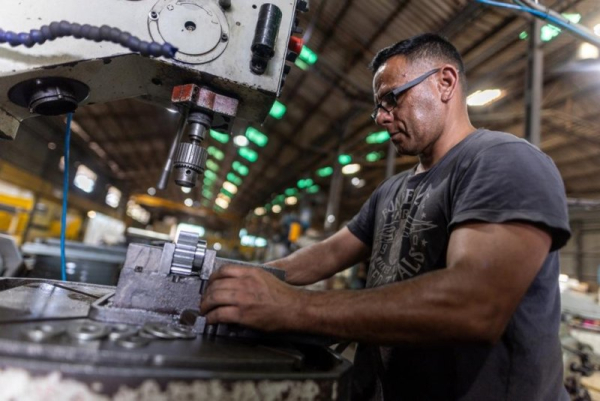
More than 22,000 companies have closed and more than 300,000 formal jobs have been lost in Argentina over the past two years as a result of a trade liberalization policy that reduced tariffs with the promise of lowering consumer prices, a trade association says. File Photo by Juan Ignacio Roncoroni
The announcement of the closure of FATE, the only tire manufacturer entirely owned by the Argentine capital and with more than 80 years of history, became the most visible symbol of the fracture facing industry under the government of Javier Milei.
FATE’s decision, announced on Wednesday, was made due to the company’s inability to compete with a wave of imported tires arriving from Asia at prices far below local costs.
FATE’s case was not isolated. According to the association Industriales Pymes Argentinos, or IPA, more than 22,000 companies have closed and more than 300,000 formal jobs have been lost over the past two years as a result of a trade liberalization policy that reduced tariffs with the promise of lowering consumer prices.
This strategy left local production facing competition that many business owners describe as unequal and difficult to sustain.
Daniel Rosato, the IPA president, told UPI that over the past two years, the country experienced an avalanche of imports, ranging from capital goods to food products.
He said Milei’s government reduced tariffs to boost competitiveness, but the outcome was different.
“Argentina has very high dollar-denominated costs and the domestic industry was unable to compete against cheaper imported products, many of these come from Asia,” Rosato said.
“It is very difficult to compete with China. This led the industry to begin producing less due to a lack of competitiveness. The recession is deepening. Factory closures affect not only small companies, but the entire industrial sector,” he said.
Economist Leonardo Park, a researcher at the think tank Fundar, said the government implemented a sweeping deregulation of foreign trade.
Some of these measures, he said, were necessary, such as eliminating bureaucratic systems that previously delayed or limited product imports and simplifying the permits companies needed to bring goods from abroad.
However, tariffs were also reduced, technical standards relaxed, customs controls loosened and the anti-dumping system was reformed.
“All of these reforms generated strong growth in imports since last year,” he said.
Park warned that a rapid increase in foreign purchases creates a risk for local production, as it competes directly with it.
“A drop in production can translate into a risk for the employment associated with that activity,” he said, adding that FATE’s case illustrates such an impact.
“More imported tires mean less domestic production,” Park said. “When production falls, companies downsize or close. The final effect is layoffs and job losses.”
The economist also pointed to two central concerns: the loss of industrial capabilities the country already developed and employment.
“Displaced workers often face difficulties finding jobs in other sectors, whether due to a lack of dynamism in the labor market, a shortage of new skills or because growing activities are concentrated in other regions,” Park said.
From a legal perspective, labor attorney Walter Mañko, partner at Deloitte Legal Argentina, said the company cited a loss of competitiveness that made the business unviable.
“It is true that tires coming from China have a much lower cost than those manufactured in Argentina and that generates a decline in domestic demand,” he said.
Mañko also underscored the social impact. The 920 jobs lost with FATE’s closure represent families that could be left without income. In economic terms, he added, the country loses its main tire manufacturer, a loss that he said cannot be overlooked.
After the closure announcement, Milei’s government intervened through the Labor Secretariat and ordered mandatory conciliation. It is a legal tool the state can activate without prior request from the company or the union to halt the conflict and restore the situation to the point before the crisis.
For 15 days, with the possibility of extending the period by five more, both sides must sit down to negotiate. The room for agreement is narrow. What happens in those talks will not only define FATE’s future, but also send a signal about Argentina’s industrial direction in this new economic phase.
