


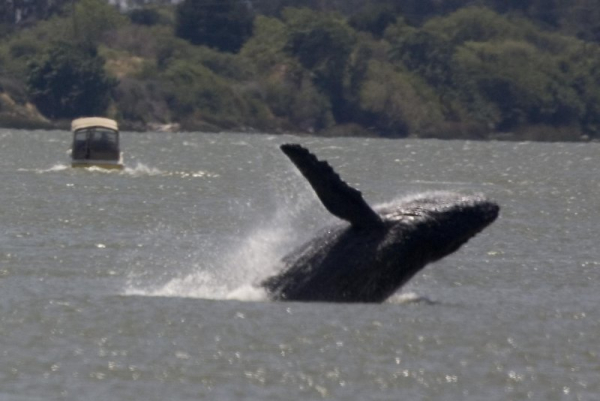
A humpback whale breaches in the Sacramento River near Rio Vista, Calif., on May 27, 2007. File Photo by Aaron Kehoe/UPI | License Photo
Two humpback whales have made one of the longest known crossings ever documented between breeding areas, traveling between the waters off eastern Australia and Brazil.
The findings, published in The Royal Society on May 20, show how researchers used decades of whale photographs to identify two humpbacks that moved between breeding grounds separated by more than 9,000 miles.
Instead of using real-time GPS tracking, researchers analyzed images of over 19,000 whales since 1984 and found two that have swum between the southwestern Pacific and the southern Atlantic oceans.
“The actual routes connecting these locations remain unknown,” researchers said.
The breakthrough came from studying photos of the whales’ tail flukes, which are as unique as fingerprints and can be used to identify individuals.
“Individual humpback whales have been tracked over time via a method called photo-identification (hereafter, ‘photo-ID’) based on the unique shape and colour patterns on the ventral surface of their tail flukes,” researchers explained in the study. “This technique has become a cornerstone of wildlife population studies, allowing researchers to monitor the migratory destinations and site fidelity of individuals across years and ocean basins.”
One of the whales was first photographed in 2003 at Brazil’s Abrolhos Bank and then seen again in 2025 in Hervey Bay, Queensland. Another was photographed in Hervey Bay in 2007 and 2013 before later being documented off the coast of São Paulo in 2019.
These cross-ocean voyages appear to be exceptionally rare, likely one-time or very infrequent movements rather than part of a regular migration pattern.
“Although such events occurred in only 0.01 of identified whales, continued global collaboration through photo-identification platforms will be essential for detecting and quantifying these rare exchanges,” the study explained.
|
Researchers say even these rare exchanges could have long-term effects on humpback whale populations. |
“Even at the low rate observed here, such exchanges could, over time, contribute to the maintenance of genetic diversity and to the horizontal transmission of song traditions among Southern Hemisphere populations.”
