

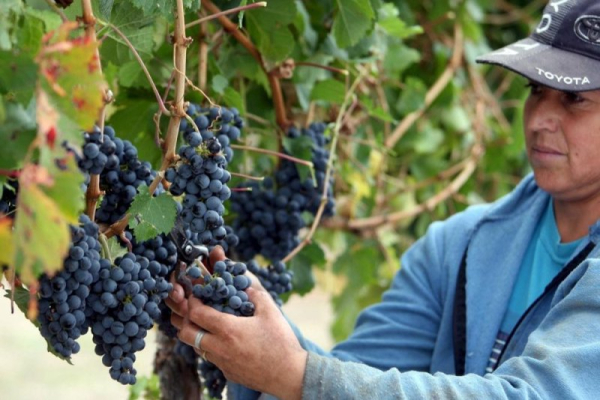
In 2025, Argentine wine exports totaled 51 million gallons, a year-over-year decline of 6.8% and the lowest volume since 2004. File Photo by Cezaro de Luca/EPA
Argentina’s wine industry is undergoing a deep crisis, as long-established wineries face severe financial strain, domestic consumption drops sharply and exports fall to levels not seen in more than two decades.
Iconic producers such as Norton and Bianchi have begun debt renegotiations or turned to legal mechanisms to avoid bankruptcy after accumulating large unpaid obligations. The financial deterioration points to structural problems that affect much of the wine value chain.
The international environment has offered little relief. In 2025, Argentine wine exports totaled 51 million gallons, a year-over-year decline of 6.8% and the lowest volume since 2004.
The United States is Argentina’s main export destination and accounts for more than half of the sector’s foreign sales.
Jose Gimenez, CEO of Viña Cobos, told UPI that Argentina remains highly dependent on the U.S. market. Of roughly $650 million in wine exports, about 25% is shipped to the United States, he said.
Gimenez linked part of the current crisis to global inflation in recent years, particularly after the COVID-19 pandemic.
“Many wineries raised prices, but the market did not accept those increases,” he said. “That seriously hurt profitability and led to a global drop in consumption.”
Rising competition has compounded the problem. Over the past 15 years, wine supply has grown far faster than demand. Gimenez noted that a U.S. supermarket can offer wines from about 2,000 different wineries, with more than 5,000 labels.
He also cited tariffs imposed during the Trump administration, which increased the cost of imported wine by about 10% and reduced its competitiveness in the U.S. market.
Gimenez pointed to a global shift in consumption habits.
“Trends matter a lot. There is growing interest in nonalcoholic drinks, lower-alcohol beverages or products perceived as healthier,” he said. “Wine has lost ground, especially among younger generations that drink less alcohol.”
That shift has weighed more heavily on lower-priced wines.
“The decline in that segment is stronger than in higher-value wines,” he said.
At home, the domestic market has also deteriorated sharply. Wine consumption fell 12.5% in November 2025, according to data from Argentina’s National Institute of Viticulture.
Economist Elena Alonso, co-founder of consulting firm Emerald Capital, told UPI that falling wine consumption largely reflects macroeconomic pressures. She cited high inflation, declining purchasing power and years of stagnating real incomes.
“This environment has directly affected consumption of nonessential goods, such as wine,” Alonso said.
She said wine competes with other mass-consumption products as households prioritize basic expenses. She also noted changing habits among younger consumers, with lower demand for alcoholic beverages overall.
The sector entered the downturn with high inventory levels and sale prices that lagged inflation. According to Alonso, the industry’s main challenge is not production capacity, which remains relatively stable, but difficulty placing its product.
“Both in the domestic and export markets, sales are struggling to absorb available wine volumes,” she said.
Gimenez also warned about Argentina’s loss of competitiveness due to its heavy tax burden.
“With such high taxes, Argentina competes at a disadvantage against other wine producers, such as Chile, the United States or New Zealand,” he said.
He recalled that years of high inflation and repeated devaluations created an unsustainable environment, with artificially high profit margins.
“Constant inflation and devaluations made it possible to pass price increases on to the market and made Argentina very cheap for tourists,” he said.
He cited examples from four years ago, when foreign visitors could stay in luxury hotels for about $100 a night and dine at top restaurants for about $50.
“That did not reflect a balanced economy, but a severe macroeconomic distortion,” he said.
As those conditions reversed, demand linked to low-cost tourism also declined.
“Tourists attracted by exceptionally low prices stopped coming and that level of consumption disappeared,” he said.
Gimenez said that once the inflation and devaluation cycle slowed, the market entered an adjustment phase.
“Companies that are not competitive or well organized must adapt to compete. Otherwise, they disappear,” he said.
He argued the sector needs stronger government support and a clearer strategy to position Argentina’s country brand abroad.
“There is a lot of work to do. Some people do not even know where Mendoza is,” he said, referring to Argentina’s main wine-producing region.
He added that reviewing trade agreements, including those within Mercosur and ties with the United States, could help ease pressure.
“European and U.S. markets are very price sensitive. Selling a wine at $10 is not the same as selling it at $11 or $12. That difference can determine how much you sell,” he said.
Alonso said that amid rising costs and ongoing restructuring, the industry needs structural reforms to improve long-term competitiveness.
