

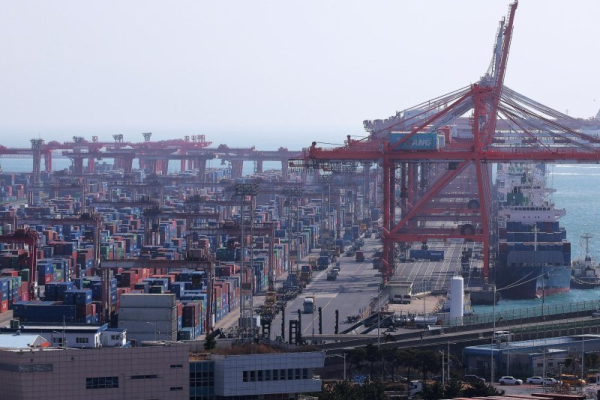
The Bank of Korea on Thursday raised its 2026 growth forecast to 2 percent, citing strong exports. In this photo, containers are stacked at a port in Busan on Monday. Photo by Yonhap
The South Korean central bank on Thursday raised to 2 percent its growth forecast for the local economy this year, citing strong exports and a recovery in private consumption.
The revision by the Bank of Korea (BOK) represents a 0.2 percentage-point increase from its previous forecast of a 1.8 percent expansion issued in November.
The revised outlook aligns with the government’s growth forecast, while being slightly more optimistic than the 1.9 percent projections by the International Monetary Fund (IMF) and the Korea Development Institute (KDI).
The Organization for Economic Cooperation and Development (OECD) expects a 2.2 percent expansion, while eight major global investment banks, including Citi, UBS and Nomura, forecast an average growth of 2.1 percent this year.
“The upgraded outlook is underpinned by a strengthening semiconductor upcycle and a stronger-than-expected global economic backdrop, despite the impact of U.S. tariffs and a sluggish recovery in construction investment,” the BOK said in a release.
The revised outlook was slightly above the country’s potential growth rate of around 1.8 percent.
Reflecting the upbeat outlook, the BOK kept the key interest rate unchanged at 2.5 percent, emphasizing financial stability amid housing market volatility and a weakened local currency.
Specifically, the BOK expects private consumption to grow 1.8 percent this year and facility investment to increase 2.4 percent. Exports are projected to expand 2.1 percent, far higher than the previous forecast of 1.4 percent.
The central bank also raised its forecast for this year’s current account surplus to a record US$170 billion from $130 billion. Last year’s surplus reached an all-time high of $123.1 billion.
“The semiconductor industry and other IT sectors are expected to contribute about 0.7 percentage point to this year’s economic growth, compared with 0.6 percentage point last year,” BOK Gov. Rhee Chang-yong told a press briefing.
He also noted that improved income conditions and a subsequent rise in private consumption, driven by solid corporate earnings, could lift the country’s economic growth by about 0.05 percentage point.
“But gaps between the IT and non-IT sectors are widening, as growth in the non-IT sector is projected to remain at 1.4 percent this year,” Rhee said.
The sluggish construction sector is another source of concern and could bring down this year’s growth by about 0.2 percentage point, he added.
For 2027, the central bank lowered its growth forecast to 1.8 percent from the previous projection of 1.9 percent, reflecting a base effect from this year’s higher growth estimate.
If semiconductor exports continue to post strong growth, the BOK expects the economy to expand further by 2.2 percent this year and 2.1 percent next year.
Under a pessimistic scenario, where the artificial intelligence (AI) boom fades and semiconductor export growth slows sharply, the growth rate could end up at 1.8 percent this year and 1.5 percent next year, according to the BOK.
“The growth outlook is subject to substantial uncertainty surrounding the semiconductor cycle, the global trade environment and international financial markets. For inflation, global oil prices and exchange rate movements constitute key risk factors,” the BOK said.
Meanwhile, the BOK revised up its consumer price inflation forecast, raising this year’s estimate to 2.2 percent from 2.1 percent amid higher global oil prices driven by geopolitical risks.
“Cost increases in certain items, such as electronic devices and insurance premiums, have added to inflationary pressures, while demand-side pressures remain subdued,” the BOK assessed.
Copyright (c) Yonhap News Agency prohibits its content from being redistributed or reprinted without consent, and forbids the content from being learned and used by artificial intelligence systems.
