


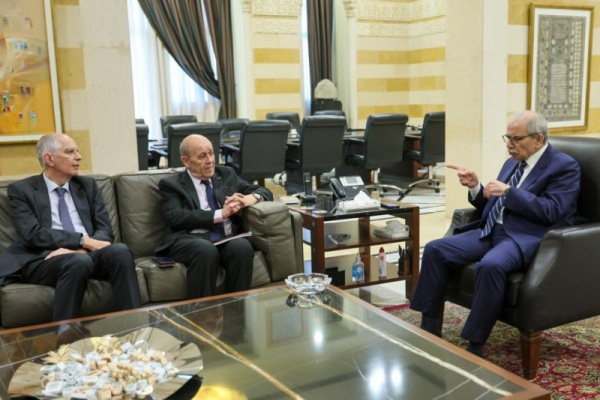
Special Presidential Envoy to Lebanon Jean-Yves Le Drian (C), flanked by French Ambassador to Lebanon Herve Magro (L), attends a meeting with Lebanese Prime Minister Nawaf Salam at the Government Palace in Beirut, Lebanon, on Thursday. The meeting was part of a French push to lock in three priorities: reconstruction, economic revival and support for the Lebanese Army, while pressing Beirut to continue reforms and assert state authority. Photo by Wael Hamzeh/EPA
Lebanon on Friday launched a new, urgent humanitarian appeal, its second since the latest escalation in the Israel-Hezbollah war began in March, seeking an additional $331.5 million to assist 1.4 million people displaced or affected by the conflict.
The appeal would bring the total funding required through the end of August to $639.9 million, according to government figures.
Speaking at a conference in Beirut attended by ambassadors of donor countries and representatives of international organizations and U.N. agencies, Prime Minister Nawaf Salam said the humanitarian crisis “is deepening with each passing day” as the war continues.
“Today, the scale of the tragedy is greater, the burden of response is heavier and the needs are no longer merely emergency needs. They increasingly require more sustainable solutions,” Salam said.
He called for increased pressure on Israel to halt its attacks on civilians and end the destruction of homes, villages and historical sites in southern Lebanon, describing it as a “policy of collective punishment” that cannot create security but “only generates more pain, anger and devastation, undermining every prospect for stability.”
Salam also criticized Iran — Hezbollah’s patron and primary weapons and funding supplier — for involving south Lebanon in its conflict with the United States and rejecting a new U.S.-mediated cease-fire understanding achieved between Lebanon and Israel in Washington on Wednesday.
He accused Iran of using south Lebanon and its people as “a bargaining chip” to improve the terms of its negotiations with Washington, saying the ongoing war “is not being fought for Lebanon’s interests, but rather on Lebanese soil and at the expense of the Lebanese people.”
Salam warned that the humanitarian crisis will worsen amid continuing hostilities, with large numbers of displaced families unable to return anytime soon to towns and villages that have been completely destroyed.
He called for supporting Lebanon’s second humanitarian appeal, saying that the gap between “needs and available resources has widened.”
U.N. Resident and Humanitarian Coordinator Imran Riza warned that the toll on Lebanese civilians is “alarming and worsening by the day,” citing widespread and repeated displacement, destruction of housing and basic service infrastructure, and far-reaching psychological trauma.
According to the Lebanese Health Ministry on Friday, some 3,558 people were killed and 10,870 wounded since March 2. More than 1.2 million people have been displaced so far displaced, with some families reporting that they were forced to move five times.
Riza said health workers and first responders are facing death and injury “on a horrific scale,” while entire neighborhoods have been turned to rubble, families have lost their homes and livelihoods, and food security is rapidly deteriorating.
“The people of Lebanon have developed a remarkable strength to withstand the hardest of times, but even this exceptional resilience has its limits,” he said, calling for an additional $331.5 million that would bring the total to $639.9 to sustain life-saving efforts for 1.4 million people through August.
Riza emphasized that the escalation of violence must stop first, saying there is “no military solution,” and called for the protection of civilians, aid workers, medical personnel, and civilian infrastructure, as well as increased humanitarian funding.
According to the United Nations Office for the Coordination of Humanitarian Affairs, the crisis in Lebanon is severe and deteriorating, with continued hostilities driving additional and forced displacement on orders issued by Israeli forces, constraining humanitarian access and limiting prospects for safe return.
The U.N. agency warned that shelter capacity is overstretched, essential infrastructure is severely damaged, and access to basic services is increasingly constrained.
It added that livelihoods remain disrupted, particularly in agriculture and small-scale commerce, deepening economic vulnerability as affected people rapidly exhaust their coping capacities.
OCHA, moreover, warned that the combined impact of displacement, economic hardship, and infrastructure damage is fueling rising tensions and protection risks.
