


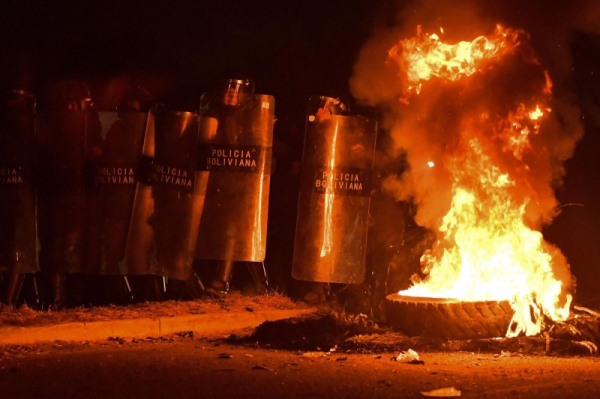
Bolivian Police clash with protesters during a roadblock clearance operation in Cochabamba, Bolivia, on June 8. Photo by Jorge Abrego/EPA
More than 5,000 cargo truck drivers are stranded on Bolivian highways, according to Bolivia’s National Chamber of Transport. The transport operators were carrying goods when they were caught by roadblocks and protests staged by demonstrators seeking the resignation of President Rodrigo Paz.
Bolivia’s Ombudsman’s Office, the Red Cross and the Bolivian Catholic Church launched a humanitarian aid caravan Monday to assist the drivers, who have faced shortages of food, medicine and hygiene supplies for more than 40 days.
Among those affected are Claudio Arrúa Miranda, Braulio Ibarrola and Óscar Ibarrola, three Paraguayan truck drivers who remain stranded near the Peru-Bolivia border, about 87 miles from La Paz and at an altitude of 13,451 feet, amid a roadblock preventing them from continuing their journey back to Paraguay.
The drivers were returning from Lima with commercial cargo bound for Paraguay when they became trapped by road closures in Bolivia. Each truck is carrying about 26 tons of merchandise, including raw materials used in the production of footwear, fabrics and lubricants.
“Today marks 44 days that we’ve been stranded here, and the situation is difficult. We’re at 13,451 feet above sea level and the cold is intense,” Arrúa told Paraguayan television channel NPY.
According to the driver, temperatures drop to as low as 14 degrees Fahrenheit during the early morning hours, and assistance from Paraguayan authorities has been limited. The truckers have survived thanks to support from relatives, fellow drivers and private donors.
The possibility of returning through an alternative route also faces financial obstacles. According to Arrúa, one option would be to travel back through southern Peru, cross into Chile and then enter Argentina before reaching Paraguay, but the detour would involve additional costs of nearly $3,000.
The conflict, driven by groups demanding the resignation of President Rodrigo Paz, has left thousands of transport operators living in precarious conditions across five of the country’s nine departments.
The Sayari area, on the highway connecting Cochabamba and Oruro, is one of the most critical locations due to extreme winter temperatures.
Fernando Herbas, an international heavy transport driver, told a Santa Cruz television station that about 250 drivers stranded in Sayari are facing a critical situation because of shortages of drinking water, food and basic services.
Herbas said the group had advanced through several locations using partial humanitarian corridors before reaching Sayari, where stores had already run out of products needed to supply hundreds of drivers.
He also said the roads have been damaged by the use of explosives and alleged that those enforcing the roadblocks are restricting traffic and even controlling people’s movements in the area.
Roadblocks maintained by demonstrators in Bolivia for more than six weeks have caused economic losses exceeding $2.76 billion, Bolivia’s National Chamber of Industries said Tuesday.
The organization said the accumulated losses are equivalent to 5.5% of the country’s gross domestic product and estimated the economic impact at about $60 million per day.
According to Bolivian newspaper El Deber, the industrial sector is among the hardest hit by the transportation restrictions, with estimated losses of $12 million per day and cumulative losses of $552 million during the conflict.
The business group currently counts 50 active roadblocks across Bolivia, distributed among the departments of La Paz, Cochabamba, Oruro, Potosí and Santa Cruz. The organization warned that the restrictions continue to affect the supply of goods, employment and regional trade.
Although Bolivian President Rodrigo Paz signed into law legislation regulating states of exception last week, he has not yet ordered the deployment of the Armed Forces to clear the highways.
