

The last active pro-Palestinian hunger strike in British prisons has ended after Muhammad Umer Khalid was hospitalized with organ failure.
Khalid, 22, had been refusing food for 17 days but escalated his hunger strike to include water Friday, which led to his hospitalization Sunday.
“At the hospital, in the afternoon, I was given a choice between treatment and likely death within the next 24 hours due to kidney failure, acute liver failure and potential cardiac arrest,” Khalid said in a statement.
He said he ended his hunger strike partly because there is more he wants to do and because British officials “have no concern for our lives and they do not care if we die in these cells.”
Khalid said if British Prime Minister Keir Starmer and Deputy Prime Minister David Lammy “[wish] to see me dead, they can come and do it themselves.”
He is an inmate in West London’s Wormwood Scrubs prison, where he is awaiting trial on charges arising from his alleged participation in a break-in of the Royal Air Force base at Brize Norton in June.
His hospitalization occurred after 86 protesters forced their way onto the jail’s grounds on Saturday.
Khalid cited the protesters as helping him to end his hunger strike on Sunday afternoon and enter the prison hospital.
London police said the protesters entered the prison grounds in support of Khalid and will be arrested and charged with aggravated trespass for refusing to leave the grounds.
Khalid was among five British prisoners who initiated a hunger strike to oppose the government’s now-canceled contract that would have paid $2.7 billion to an Israeli firm Elbit to train 60,000 British soldiers.
The prison’s governor has agreed to meet with Khalid and ended restrictions on his visitors while he is awaiting trial.
IDF move tanks along border fence
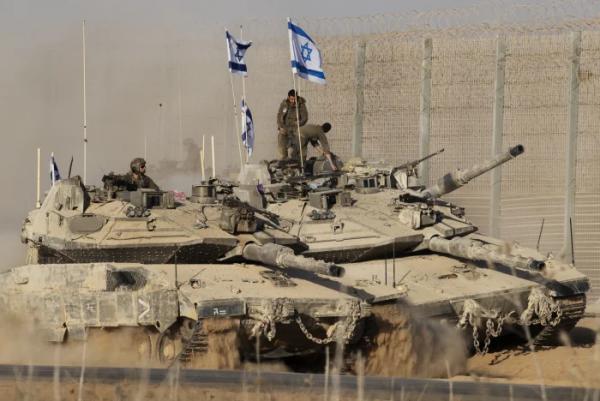
Israeli tanks move out from a position along the border fence with the Gaza Strip on October 20, 2025. Photo by Jim Hollander/UPI | License Photo
