

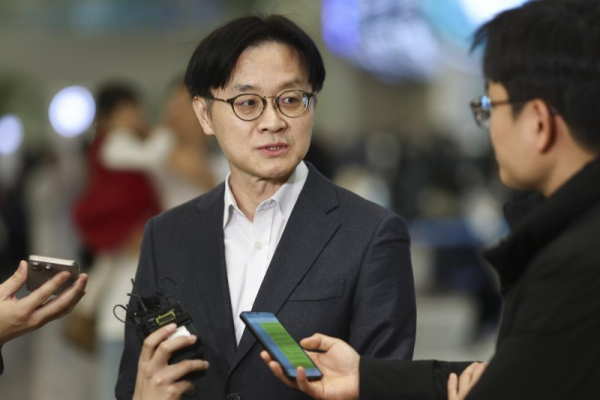
Kim Jeong-kwan, South Korea’s minister of trade, industry and energy, speaks to reporters upon arrival at Incheon International Airport after returning from tariff talks in Washington. Photo by Yonhap News Agency
South Korea’s efforts to head off a proposed 25% U.S. tariff increase stalled after trade talks in Washington ended without agreement, prompting the auto industry to accelerate investment plans in the United States.
Trade, Industry and Energy Minister Kim Jeong-kwan returned to South Korea after two days of discussions with U.S. Commerce Secretary Howard Lutnick on President Donald Trump’s proposed reciprocal tariff hike. The talks, held Wednesday and Thursday in Washington, concluded without concrete results, the ministry said.
During the meetings, Kim stressed that South Korean companies were prepared to expand U.S. investment and said the government was coordinating with the National Assembly to swiftly pass a special law aimed at supporting large-scale Korean investment in the United States.
The proposed legislation is intended to reduce uncertainty for Korean firms and institutionalize strategic economic cooperation between the two countries. Seoul argued that the bill would boost U.S. job creation and economic growth.
U.S. officials, however, reportedly questioned whether the Korean government’s position would translate into concrete action, signaling that legislative intent alone would not be sufficient.
The stalled talks have heightened concerns in South Korea’s auto industry. Hyundai Motor Group, a major exporter to the U.S., is expected to adjust its existing investment strategy to accelerate the pace of spending.
Hyundai Motor President José Muñoz told The Wall Street Journal on Friday that he believes President Trump understands Hyundai’s commitment to the U.S. market and said the company is focused on speeding up its investment plans.
Hyundai previously announced plans to invest $26 billion (about 37.7 trillion won) in the United States by 2030, with a goal of locally producing 80% of the vehicles it sells there.
Industry analysts expect uncertainty surrounding the proposed tariff hike to continue until at least mid-March, as South Korea’s National Assembly plans to process the U.S. investment bill in late February or early March.
Democratic Party policy chief Han Jeong-ae said the bill would first be reviewed by the National Assembly’s finance and economy committee, adding that passage is likely within that timeframe.
The Trump administration has previously indicated it would not discuss tariff reductions until the legislation is approved, suggesting that negotiations on easing the proposed 25% tariff may resume only after the bill’s passage.
Some experts described the tariff threat as a temporary pressure tactic. Kim Pil-soo, a professor of automotive engineering at Daelim University, said the move appears aimed at showcasing policy achievements ahead of U.S. midterm elections, adding that continued investment and passage of the bill could eventually lead to a resolution.
— Reported by Asia Today; translated by UPI
© Asia Today. Unauthorized reproduction or redistribution prohibited.
Original Korean report: https://www.asiatoday.co.kr/kn/view.php?key=20260201010000191
