

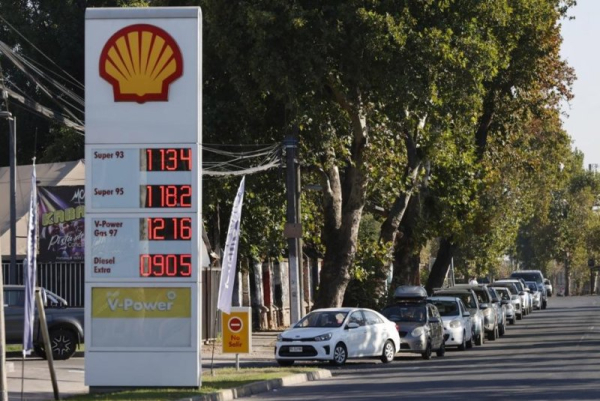
Vehicles line up for fuel in Santiago, Chile, on Tuesday. The transporters’ union, one of the most powerful in Chile, warned that the historic rise in fuel prices announced by Chile’s new president, José Antonio Kast, will increase costs throughout the country’s entire logistics chain. Photo by Elvis Gonzalez/EPA
Chile on Thursday implemented an unprecedented increase in fuel prices, giving the country some of the highest costs in the region and adding upward pressure on inflation.
The hike follows an energy crisis linked to the war in the Middle East and a sharp adjustment to a state subsidy mechanism that cushions international price volatility. Gasoline prices rose by about 32% and diesel by 58%, equivalent to an increase of nearly 50 cents per liter.
According to consulting firm GlobalPetrolPrices, which tracks fuel costs in 170 countries, the increase places Chile among the most expensive markets in Latin America, surpassed only by Uruguay and above the global average, local outlet Emol reported.
Ahead of the price adjustment, long lines formed Wednesday at gas stations in Santiago as drivers rushed to fill their tanks, CNN Chile reported.
President José Antonio Kast described the measure as a “painful but unavoidable step” to prevent a broader economic crisis. He said the government can no longer subsidize fuel prices while international oil prices exceed $100 per barrel.
The government said the decision to pass the increase directly to consumers, rather than phase it in gradually, was driven by fiscal constraints and the high cost of maintaining subsidies, estimated at about $140 million per week.
Chile is one of the region’s largest oil importers and relies heavily on trucking for domestic distribution due to limited rail infrastructure. The Kast administration announced mitigation measures focused on public transportation and freight.
However, freight transport groups and the food industry warned that higher logistics costs will inevitably be passed on to basic goods, raising uncertainty about April’s consumer price index.
Chile’s central bank lowered its economic growth forecast, projecting gross domestic product growth between 1.5% and 2.5%, local newspaper La Tercera reported. The revision reflects weaker-than-expected performance in the mining sector and a more challenging global environment.
The central bank also warned inflation could rise toward 4%, delaying a return to its 3% target until 2027. The main factor behind the revision is the expected impact of higher oil prices on fuel costs.
In response, the bank decided to keep its benchmark interest rate at 4.5%, stating that any future rate cuts will depend on inflation returning to its target path.
