

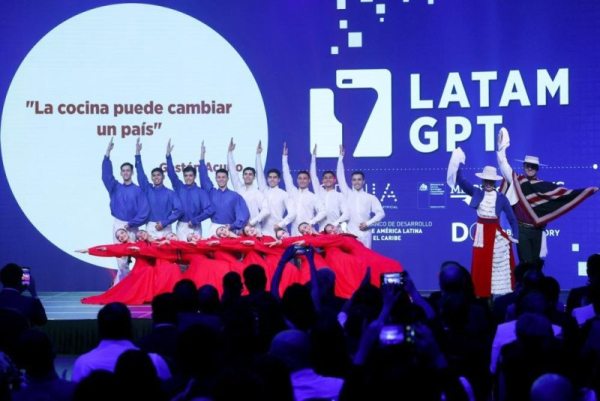
Members of the Chilean Folk Ballet (Bafochi) perform during the launch of Latam-GPT in Santiago, Chile, on Tuesday. It’s a new artificial intelligence tool programmed to eliminate bias against Latin American and Caribbean cultures. Photo by Elvis Gonzalez/EPA
After nearly three years of development, Chile officially launched Latam-GPT, an open-source artificial intelligence model built with data from Latin America to reflect the region’s culture and history.
“I am Latam-GPT, a large language model developed specifically for Latin America, with emphasis on its culture, language, history and social realities,” the platform said in its self-introduction.
It added that its goal is “to provide artificial intelligence that better reflects the diversity and complexity of Latin America, promoting digital sovereignty and local AI technology development.”
The model compiles more than 230 billion words from official sources in fields including humanities and social sciences, education, health sciences, public policy, economics, environment, arts and Indigenous communities.
Chilean President Gabriel Boric led Tuesday’s launch and highlighted international cooperation and collaboration between the public and private sectors as key to the project.
“We have a lot of data that remains outside the reach of language generators, which is why the creation of Latam-GPT is extremely valuable. We should not fear AI, but see it as an opportunity,” Boric said.
Latam-GPT involved an investment of about $3.5 million. The project is led by Chile’s National Center for Artificial Intelligence with support from Chile’s Ministry of Science, the Development Bank of Latin America and the Caribbean, or CAF, Amazon Web Services and the technology center Data Observatory.
The initiative also included collaboration from more than 15 countries and 60 organizations including universities, international institutions and technology leaders.
Developers describe the project as a regional technological milestone. Unlike many global AI systems originally trained in English, Latam-GPT was built as an open-source model primarily in Spanish and Portuguese. It also incorporates Indigenous languages and local dialects to better reflect regional identity.
“For the first time, a large-scale language model can understand our languages and diversity,” said Marcelo Facchina, principal specialist in Smart Cities and Digital Development at CAF. “It shows that AI can foster regional integration, as this effort involves unprecedented collaboration.”
Alvaro Soto, director of CENIA, said existing chatbots and language models show limited knowledge of Latin America and the Caribbean. One reason is that only about 2% to 3% of the data used to train such systems comes from the region.
Based on estimates from open repositories such as Common Crawl, Soto said about 45% of training data sources originate in the United States, followed by Russia and Germany among others. This imbalance, he said, reduces representation of Latin American realities.
“Artificial intelligence is a disruptive technology and today we are being left out of this technological revolution. We need to build capabilities so we can have a voice,” Soto said.
Latam-GPT will not initially be available as a public chatbot. Although considered a public good intended to democratize access to AI, its open-source design targets universities, governments, startups and communities so they can develop their own systems using the model.
Mauricio Leiva, Latam-GPT project manager at Data Observatory, told UPI the training phase and validation against other models have been completed. He said the model, training data, code and benchmarks will be released soon.
“Because it was trained with Latin American data, it can reason about our culture and identity with greater precision,” Leiva said. He added that launching it as a public chat platform would require significant computing capacity and long-term investment, though alternatives are being explored for 2026.
Developers plan to add multimodal capabilities allowing the system to generate not only text but also images, audio and video. Leiva said the model currently compares to ChatGPT version 3 released between 2020 and 2022.
Future versions are expected to include additional regional data, varied parameter sizes for different uses and potential funding to deploy a public chat interface accessible to broader audiences.
