

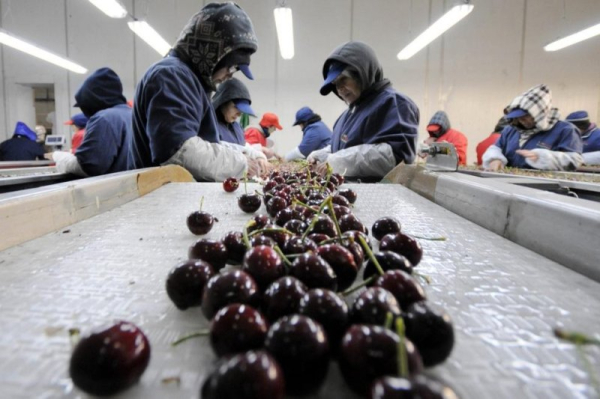
Some fruit industry analysts say the boom in Chilean cherries may have peaked and that weaker demand in China, the main export market for the fruit, could force producers to rethink supply levels. File Photo by Benjamin Hernandez/EPA
Chile’s cherry industry faces a difficult 2026 season marked by oversupply, falling prices and signs of adjustment in a sector that had seen strong export growth for years.
Some fruit industry analysts say the boom in Chilean cherries may have peaked and that weaker demand in China, the main export market for the fruit, could force producers to rethink supply levels.
Exports remain high despite softer global demand. Industry association Frutas de Chile said shipments reached 113.8 million boxes, about 590,000 tons, exceeding initial projections of 110 million boxes.
Weather conditions brought the harvest forward, concentrating a larger supply of cherries in the first weeks of January, so Chilean shipments arrived before the Lunar New Year, one of the most important holidays for consumption of this fruit.
Exporters say fruit quality remained strong, but the concentration of shipments strained the market. China’s share of Chile’s cherry exports declined from to 87% from 92%.
“Both producers and exporters did a good job. The biggest challenge has to do with the concentration of supply. From the start of the season through Jan. 20, more fruit reached China than last year,” said Frutas de Chile President Ivan Marambio, according to La Tercera.
The industry also comes off a challenging prior season, when large shipments drove prices down and millions of boxes were lost after the Maersk Saltoro cargo ship was stranded at sea for several days.
The market also reflects weaker consumption.
“There is lower purchasing power in China, which has become evident over the past year, and returns will be quite tight,” said Victor Catan, president of Fedefruta. He added the current season is likely to be more complex than the previous one, which “was already difficult,” according to TheClinic.cl.
Prices reflect pressure from oversupply. They previously ranged between between $1.36 and $2.72 per pound, but now sit between $0.68 and $1.13.
Patricio Bravo, general manager of Agrícola Don Fortunato, said the industry’s “super cycle” has ended and historically high prices are unlikely to return, adding that tighter margins mean some growers, particularly those that produce less than about 8,900 to 10,700 pounds per acre may need to reconsider whether the business remains viable, El Mercurio reported.
Juan Pablo Subercaseaux, an agronomy academic at the Catholic University, said export volumes to China have become too large and that earlier assumptions about unlimited demand there no longer hold under current economic conditions.
Authorities also acknowledge the changing outlook. Chile has built a global leadership position in cherries in just a few years and is now entering a phase of greater demands and consolidation, Agriculture Minister Ignacia Fernández said.
In her view, changes in international markets are forcing the industry to adjust and refine its supply, diversify markets and raise quality standards.
The expansion of planted area reflects the sector’s scale. Chile’s Agriculture Ministry statistics office reports 77,765 hectares of cherry orchards, about 16.4% of total fruit-growing land, compared with 24,498 hectares a decade ago.
Given that growth, Subercaseaux said exports should return to levels above 85 million boxes, which would involve removing more than 30,000 hectares of cherry orchards.
