

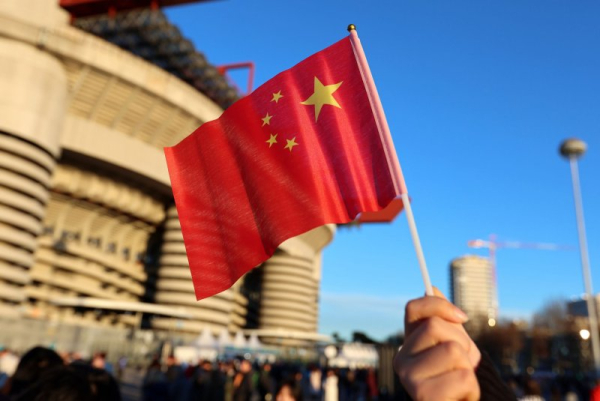
China’s Tianqi Lithium Corp. announced plans to reduce its 21.9% stake in Chilean lithium producer SQM, the world’s largest lithium company. Photo by Aaron Josefczyk/UPI | License Photo
China’s Tianqi Lithium Corp. announced plans to reduce its stake in Chilean lithium producer SQM, the world’s largest lithium company, where it holds a 21.9% share, as Chile moves to restructure its lithium industry through a major state-backed partnership.
In a filing to the Hong Kong Stock Exchange, the Chinese firm said it approved a divestment plan to sell 1.25% of its holdings within one year, Chilean financial newspaper Diario Financiero reported.
Tianqi had initially notified the exchange it would sell 100% of its stake in SQM. The notice was withdrawn minutes later and replaced with the smaller divestment plan.
The announcement came after Chile’s Supreme Court ruled against Tianqi’s legal challenge seeking to block SQM’s lithium partnership with state-owned copper giant Codelco to develop resources in northern Chile.
Tianqi argues the alliance affects its interests as a shareholder. The Chinese company paid about $4.1 billion in 2018 to acquire its stake in SQM.
The firm has opposed NovaAndino, the joint venture created by SQM and Codelco to develop lithium in the Salar de Atacama, one of the world’s largest lithium reserve areas.
Analysts say the partnership secures production continuity in the Salar de Atacama through 2060 and reduces uncertainty affecting the global battery and electric vehicle industries.
“It reinforces Chile as a strategic and reliable supplier in an increasingly competitive market, ensuring production continuity after 2030 and greater value capture in the global chain without sacrificing competitiveness against Australia, China or new producers,” mining market specialist Victor Perez of Universidad Adolfo Ibanez told UPI.
He said the agreement provides supply stability and greater predictability in production volumes, which tends to reduce price volatility.
“For the battery and electric vehicle industry it improves access to project financing, facilitates investment decisions and reduces risks in capacity planning,” Perez added.
The project also carries global market relevance due to projected output levels. The partnership aims to produce between 280,000 and 300,000 tons annually of lithium carbonate equivalent starting in 2031, with significant cumulative output expected through 2060.
These figures position NovaAndino Litio among the world’s largest supply hubs at a time when lithium demand could multiply by 2040 driven by electric vehicle expansion and energy storage needs.
Sebastian Quinones, strategic director at the International Lithium and New Energies Chamber and Latin America head of consulting firm Rain City, told UPI the global lithium market is entering a complex phase as demand rises.
“China controls between 65% and 90% of lithium processing and 75% of cell manufacturing. Australia dominates hard rock extraction while Argentina is accelerating production with market incentives,” he said.
Chile is working to strengthen its competitive advantage as a low-cost lithium refiner with operating costs between $3,000 and $5,000 per ton and a significantly lower carbon footprint than alternative production methods, Quinones said.
He added that the Codelco-SQM partnership positions Chile “as a strategic partner both for Western countries through the U.S.-led Minerals Security Partnership and for Asia without subordinating itself to any geopolitical bloc.”
Quinones noted automakers are increasingly investing directly in mining supply chains.
“Stellantis is investing in copper and batteries, Tesla is exploring supply in Chile, BYD is vertically expanding while LG Energy Solution Panasonic and Tata Motors are seeking direct agreements with producers to secure supply chains,” he said.
By guaranteeing operations through 2060 at the world’s most productive brine deposit, Chile “mitigates a potential supply shock equivalent to 25% to 30% of global high-purity refined lithium supply,” Quinones said. He noted the industry needs massive capacity expansion toward 2040 with investments estimated between $1 trillion and $2 trillion.
For the Chilean state the joint venture also reshapes its role in the lithium value chain. The model aims for the government to capture a majority share of economic benefits with projected fiscal revenues between $30 billion and $50 billion.
Chile is South America’s largest lithium producer and the world’s second largest after Australia. According to the U.S. Geological Survey Mineral Commodity Summaries report, the country also holds the world’s largest lithium reserves at about 9.3 million tons.
