

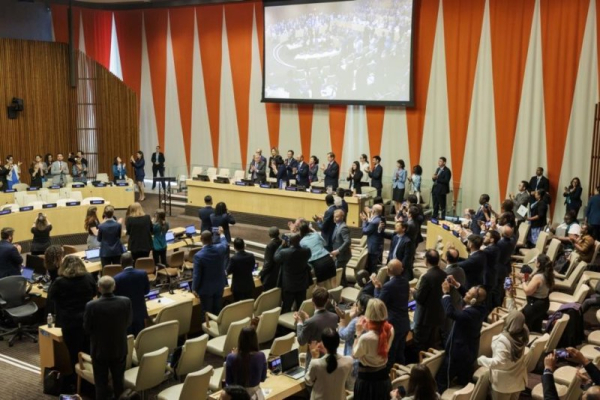
Delegates stand and applaud after the adoption of the text of the High Seas Treaty at the United Nations headquarters in New York on June 19, 2023. File Photo by Justin Lane/EPA
Delegates were gathered in the busy corridors at United Nations headquarters in New York this week for a pivotal round of talks to implement the High Seas Treaty, as a late-stage bid by China to host the agreement’s secretariat sharpens competition over who will shape the rules governing nearly half the planet.
The preparatory commission’s third session marks a pivot from diplomacy to delivery after the treaty entered into force in January, with negotiators turning to the institutional framework needed to guide cooperation, enforcement and science across the high seas.
At the center of the debate is where to locate the treaty’s secretariat — a once-technical decision that has taken on geopolitical weight since China’s late bid to host it in Xiamen, joining Chile and Belgium and drawing close scrutiny from Southeast Asian nations over whether stewardship of the global commons can be separated from ongoing tensions in the South China Sea.
For China, whose global fishing fleet, seabed interests and blue economy ambitions are deeply tied to how the high seas are regulated, the move signals a clear intent to help shape the emerging architecture of ocean governance, elevating what was once a technical discussion into a strategic contest with global implications.
From treaty to toolkit
After nearly two decades of negotiations, United Nations member states adopted the Agreement on Marine Biological Diversity of Areas Beyond National Jurisdiction in June 2023. The accord – widely known as the High Seas Treaty – entered into force in January 2026 after surpassing the required ratifications, with 145 signatories and 85 states parties to the treaty.
The treaty sets out a framework to establish marine protected areas in international waters, govern access to marine genetic resources and tighten environmental impact assessments. These measures are aimed at slowing biodiversity loss across the high seas, which cover roughly two-thirds of the world’s oceans.
But diplomats say the agreement’s success will hinge less on its text than on its execution, and on the politically charged decision over where to base its secretariat.
“China’s bid is a strong symbol and signal that it is more directly assuming a global leadership role in environmental politics,” said Professor Philippe Le Billon, geographer at the University of British Columbia.
He told UPI that Beijing’s ocean-focused diplomacy is reinforcing a broader pattern seen at Convention on Biological Diversity COP15 and its high-profile presence at COP30 last November, positioning itself as a visible player in shaping global ocean governance.
That reality has thrust the preparatory commission, tasked with designing the treaty’s operational backbone, into the spotlight. Its work includes drafting rules of procedure, establishing financing mechanisms, defining compliance structures and, critically, determining where the secretariat will be situated.
Why the secretariat matters
The secretariat will coordinate meetings of member states, manage data-sharing platforms, support scientific advisory bodies and help oversee compliance with conservation measures, including marine protected areas on the high seas. It also will shape agendas, convene expert networks and serve as a hub for capacity building among developing states.
“I think many countries would favor a Southern Hemisphere host, such as Chile, given that much of the area beyond national jurisdiction lies in southern waters and that ‘Global South’ states were central to advancing the treaty,” said Professor Emerita Lisa Levin of the Scripps Institution of Oceanography.
Until recently, Belgium and Chile were the only declared contenders. Brussels has emphasized its proximity to European Union institutions and multilateral infrastructure, while Santiago has framed its bid around equity, geographic balance and its leadership in ocean conservation in the Global South.
China’s entry into the race in January, with Xiamen, a coastal city with strong marine science credentials, as its proposed host, has altered the diplomatic landscape.
Beijing’s strategic calculus
As the world’s largest distant-water fishing nation, a major player in seabed resource exploration and an increasingly vocal advocate of the blue economy, Beijing has a direct stake in how rules governing the high seas are defined and enforced.
Hosting the secretariat would give China a front-row seat and potentially a guiding hand in shaping those rules.
“China has had a deep and serious engagement throughout the final stages of the BBNJ process and it was clear to me that they wanted to signal that they had a profound commitment to biodiversity,” Neils Krabbe, a senior law lecturer at University of Gothenburg, said in a statement to UPI.
Since Sweden served as chair of the EU council during the final phase of BBNJ negotiations, Krabbe added, that China initially pushed to keep compulsory dispute settlement outside the treaty but ultimately accepted it, while securing special carve-outs for disputed areas in the South China Sea.
Beijing in recent years has sought to recast its marine role, positioning itself as a proponent of ocean protection under its “ecological civilization” framework. Officials point to an expanded network of marine protected areas, alongside advances in ocean monitoring, scientific research and fisheries management reform.
Xiamen, home to leading marine research institutes and a track record in coastal management, is presented as a natural fit as a global ocean governance hub.
China is pressing its case that it has both the capacity and the commitment to host and support the secretariat.
“Over the past few days, more NGOs, small island states and other nations appear to be won over by China’s resolve and lobbying efforts,” Li Shou, director of China Climate Hub at the Asia Society Policy Institute, told UPI.
Skepticism and competing visions
Some Western diplomats privately express concern about transparency, data governance and the potential politicization of the secretariat if hosted in a country with expansive maritime claims and ongoing disputes in the South China Sea.
“There are indeed reservations by several signatories that if the secretariat were awarded to China, it could create a more bureaucratic, state-centric institution less conducive to full transparency and strict compliance, particularly in relation to China’s distant-water fleet and deep-sea mineral exploration,” Carlyle Thayer, an emeritus professor and veteran Southeast Asia security analyst at the University of New South Wales in Canberra, told UPI.
Others caution against framing the decision solely through a geopolitical lens. The concern is that if China is the secretariat host that it will likely push a blue economy agenda that promotes sustainable marine activities and further consolidate Chinese commercial and geo-economic interests.
The BBNJ agreement creates a mechanism to define marine protected areas that are comprehensive for everyone.
“However, the marine genetic resources component is new, filling a gap where there was previously no regulation on access and no obligations on benefit sharing, and China is positioned to be a total leader in this space,” said Robert Blasiak, an associate professor who specializes in ocean governance and marine genetic resources at the Stockholm Resilience Center.
China’s bid emphasizes inclusivity and scientific collaboration, underscored by its expansion of large-scale marine protected areas and participation in regional ocean governance efforts, including ratifying the Port States Measures Agreement, to curb illegal fishing.
That record, scientists said, strengthens Beijing’s case for a leadership role.
“China did have co-presidency over the Conference of the Parties COP15, with the Kunming-Montreal Global Biodiversity framework under the Convention on Biological Diversity,” said Jack O’Connor, a senior scientist at the United Nations University Institute for Environment and Human Security.
Implementation, social equity challenges ahead
Beyond the question of location, funding has emerged as a central concern for delegates. Developing countries have underscored the need for predictable financing and capacity-building support to participate effectively in research, monitoring and enforcement. China has pledged more than $70 million for the secretariat’s first five years, along with an additional $3 million earmarked for developing states.
The High Seas Treaty is emerging as a critical test for multilateral cooperation at a time rising geopolitical strain, with its success or failure likely to influence confidence in the effectiveness of global governance institutions.
For some governments, the offers a pathway to more deeply integrate a major power into cooperative ocean governance. For others, it raises concerns over how influence would be exercised within those frameworks.
“In conversations with senior Chinese officials at the U.N. preparatory meetings, it is clear the push to secure host status — and to project China as a global ocean steward — is being driven at the highest levels by President Xi Jinping,” said Li Shou of the Asia Society Policy Institute.
