

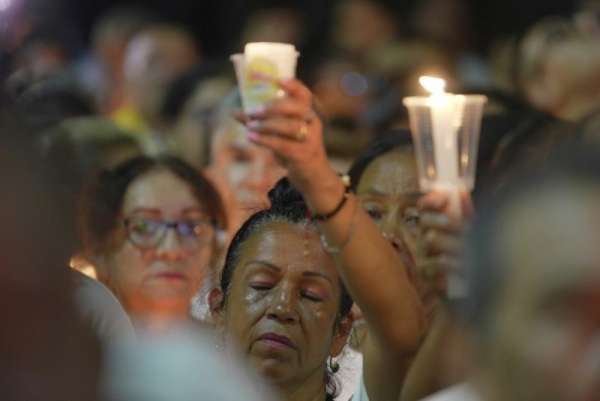
People dressed in white hold lit candles at a candlelight vigil for peace and remembrance in front of the Marco Fidel Suarez Air Base in Cali, Colombia, on Saturday. Hundreds gathered at the site of the attack in memory of the six civilians killed there in a car bomb explosion two days earlier. Photo by Ernesto Guzmán/EPA
The Ombudsman’s Office of Colombia has issued an early warning of an “imminent risk” of attacks and other extreme violence in several municipalities of Valle del Cauca, whose capital is Cali.
The warning came Monday, just four days after bomb attacks in rural Antioquia and in Cali left 18 people dead and more than 60 injured.
In its statement, the office said disputes stem from territorial control of drug-trafficking routes in the Garrapatas Canyon and other strategic corridors, creating a pattern of violence and serious crimes.
It identified three municipalities — Riofrío, Trujillo and Bolívar — where authorities have detected a strong presence of these groups and an increase in threats against civilians.
The climate of insecurity has had a direct impact on Colombia’s political landscape as the country heads into the May 2026 presidential election. That landscape already was shaken by the attack and subsequent death of presidential candidate Miguel Uribe.
Presidential candidates have adjusted their speeches and platforms to urgently address security, adopting tougher hardline language against armed groups.
Proposals under discussion include strengthening military intelligence, repealing or modifying some peace policies, building maximum-security prisons modeled after those in El Salvador and rejecting any initiative that would grant political status to armed groups.
The recent bomb attacks have reopened debate over President Gustavo Petro’s peace process, especially his “Total Peace” plan to negotiate with all of the country’s armed groups. Critics argue the strategy is too soft and fosters impunity, while supporters say the long-term solution must be political rather than solely military.
Colombia’s Attorney General’s Office and National Police are conducting operations nationwide, reviewing security camera footage, witness testimony and forensic evidence from the attack sites to identify those responsible.
President Gustavo Petro initially confirmed the arrest of two suspects in the Cali attack. They were captured by residents in a neighborhood near the attack site Thursday.
One of the detainees, Walter Esteban Yonda Ipía, is alleged to be a member of the Central General Staff, a dissident faction of the FARC. Authorities said the group — specifically its “Carlos Patiño” unit — is believed to be behind the attack.
Two others, Diomar Mancilla and Carlos Steven Obando, were accused of transporting and detonating the explosives.
In addition to the arrests, authorities have issued warrants for other suspects and offered large rewards for information leading to their capture. The strategy is intended to pressure criminal groups and encourage public cooperation, which officials say is crucial in such cases.
Defense Minister Pedro Sánchez Suárez said security has been reinforced at strategic points and that more intelligence units are being deployed to anticipate future threats.
Amid the investigations and announcements, Ecuadorian authorities on Saturday seized a shipment of industrial explosives in Carchi province, which is on the border with Colombia. Officials said the material was destined for Colombian armed groups to carry out new terrorist attacks.
