

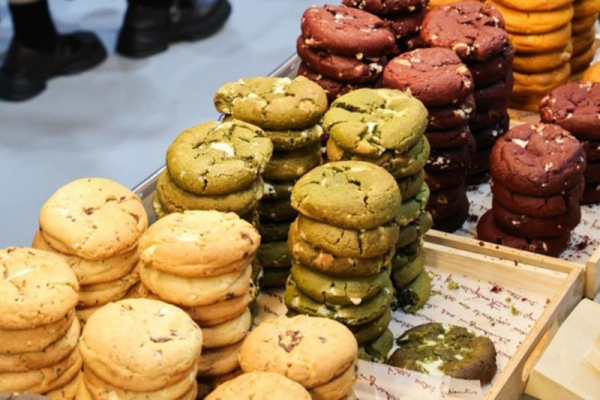
Various cookie products are on display at the 2025 Seoul Cafe & Bakery Fair that opened at Coex Magok Lewest in western Seoul, South Korea, 11 December 2025. File. Photo by YONHAP / EPA
Consumer complaints and regulatory actions tied to the popular “Dubai chewy cookie” dessert have surged in recent months, raising safety concerns as the trend spreads rapidly across South Korea.
Rep. Jeong Il-young of the liberal Democratic Party of Korea said data submitted by the Anti-Corruption and Civil Rights Commission, the Ministry of Food and Drug Safety and the Korea Consumer Agency show a sharp rise in complaints early this year.
According to the commission’s complaint data, no cases were recorded from January 2024 through October 2025. Complaints began to appear in November 2025 with one case and rose to 15 in December. In January 2026, the figure jumped to 118, accounting for about 6% of all dessert and confectionery complaints that month.
Of the 118 cases filed in January, 90 have been answered and 28 remain under review.
Regulatory measures have also increased. The food safety ministry’s integrated system showed no enforcement cases through October 2025, but recorded two in November and six in December. As of Jan. 23, 11 additional cases had been logged – 10 administrative guidance actions and one referral for prosecution – bringing the three-month total to 19 guidance cases, including one criminal complaint.
The Korea Consumer Agency’s 1372 Consumer Counseling Center received 26 consultations in January and February alone, representing 96% of all related cases over the past two years.
Reported issues include false labeling and foreign material contamination. Some products advertised the use of premium “kadaif” pastry strands but were found to contain cheaper vermicelli noodles. In one case, a consumer reported a fractured tooth caused by what was believed to be a pistachio shell embedded in the cookie. Other disputes involved online orders canceled unilaterally by sellers who then offered refunds only in store credit instead of cash.
Jeong said the dessert has shifted from a product rarely captured in official statistics to a high-risk item where complaints, consultations and administrative actions have risen simultaneously in a short period.
“With trends spreading quickly, safety and hygiene oversight at every stage – from import and manufacturing to distribution – as well as labeling, advertising and online sales management must be strengthened to prevent consumer harm,” he said.
— Reported by Asia Today; translated by UPI
© Asia Today. Unauthorized reproduction or redistribution prohibited.
Original Korean report: https://www.asiatoday.co.kr/kn/view.php?key=20260215010005168
