

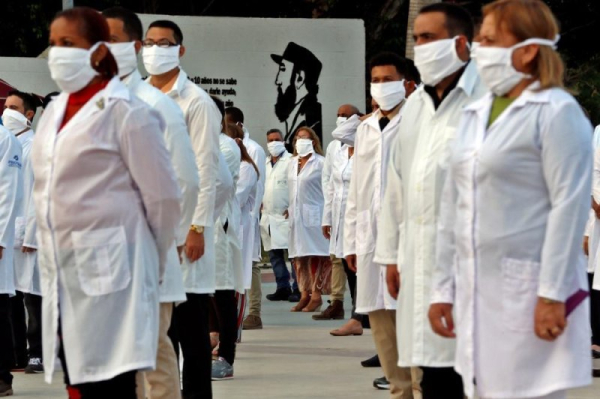
Reports say Cuba obtains billions of dollars a year through exporting professional services, including health specialists. File Photo by Ernesto Mastrascusa/EPA
Several countries in Latin America and the Caribbean have begun to end or review medical cooperation agreements with Cuba — a program that for decades allowed the island’s government to send thousands of health professionals abroad.
The system became one of the most visible instruments of Havana’s international diplomacy and an important source of income for the Cuban government.
The model is based on agreements between governments under which the host country pays Cuba for medical services, while the professionals receive only a portion of the fees. The arrangement now faces growing international scrutiny over how it operates and the labor conditions involved.
According to some studies cited by The New York Times, Cuba obtains billions of dollars a year through exporting professional services, including health specialists
Guatemala recently announced changes to the arrangement, saying it will phase out the Cuban doctors program, which had operated in the Central American country for nearly 30 years. According to the newspaper Prensa Libre, “the replacement of personnel from the island will be progressive.”
Guatemala’s Ministry of Health will fill part of the vacancies left by 412 Cuban specialists with medical students completing their residencies. The government had been paying $4.5 million annually for the program.
The changes in these agreements come as the United States pressures governments in the region to review contracts with Cuban medical brigades, citing concerns about labor exploitation and restrictions imposed on professionals sent abroad.
Secretary of State Marco Rubio announced expanded visa restrictions in February for officials linked to the program, arguing that the medical missions are part of a labor export system that financially benefits the Cuban government.
“Cuba’s labor export programs, which include medical missions, enrich the Cuban regime,” Rubio said.
Washington contends that the model could involve labor exploitation, while the Cuban government rejects those accusations and says the program is an international health cooperation initiative that has helped bring medical care to regions that face health personnel shortages.
In Honduras, the government decided not to renew its health cooperation agreement that allowed Cuban doctors to work there. As a result, 128 professionals will have to leave once the agreement expires, according to Cuba Headlines.
Honduran Vice Minister of Health Eduardo Midence said Cuban doctors will be replaced by national professionals or by properly accredited foreign specialists.
In Guyana, the health minister, Frank Anthony, said the Cuban government decided to withdraw its medical brigade after talks with Georgetown, ending a cooperation agreement that had lasted more than 48 years.
After the doctors formally leave, Guyana will allow Cuban physicians and nurses to work in the country independently, as long as they obtain certification from local health authorities.
In Jamaica, the government reviewed its health agreement with Cuba and reported irregularities in how the program operated.
Jamaican authorities also said some doctors did not have direct control over their passports and that the agreement did not specify what portion of the salary ultimately went to the professionals, raising questions about compliance with local labor laws.
The debate over Cuban medical brigades has intensified in recent years. Other countries in the Americas and the Caribbean have also taken action on the brigades after years of criticism from human rights groups, some of whom have described the system as a form of modern-day slavery.
Brazil provides one of the most prominent precedents for the regional debate over Cuba’s medical missions. The Mais Médicos program relied heavily on Cuban physicians until 2018, when Cuba withdrew thousands of doctors after changes introduced by the Brazilian government under then-President Jair Bolsonaro.
At the time, Havana objected to new requirements that Cuban doctors receive their full salaries directly and have their professional credentials revalidated in Brazil.
The collapse of the program marked one of the largest withdrawals of Cuban medical personnel from a foreign country.
Paraguay also suspended a health cooperation memorandum signed with Cuba in December 2024 that could have revived medical collaboration programs between the two countries.
According to reports cited by the Miami-based Foundation for Human Rights in Cuba, the government in Asunción halted the agreement amid concerns raised internationally about the labor conditions of Cuban medical personnel working abroad.
In St. Vincent and the Grenadines, the government recently announced plans to reduce its reliance on Cuban medical personnel as part of a broader strategy to localize medical staffing.
Prime Minister Godwin Friday said the country will begin a three-year phaseout of Cuban District Medical Officers, citing language barriers in patient care and the cost of maintaining foreign medical staff.
The policy marks a shift from the position previously defended by the Caribbean nation. In 2025, then-Prime Minister Ralph Gonsalves rejected U.S. allegations that Cuban medical missions involved forced labor, saying his government had provided Washington with evidence that the program complied with international labor standards.
“There is no human trafficking here, no forced labor, none of that,” Gonsalves said at the time, adding that Cuban medical personnel working in the country had their own bank accounts, received compensation comparable to national workers and were free to enter or leave the program, according to The Guardian.
Cuba’s overseas medical missions remain active in several countries in Latin America and the Caribbean, particularly in nations that face shortages of health professionals.
Programs involving Cuban medical personnel continue to operate in countries that include Mexico, Venezuela, Bolivia and Nicaragua, as well as in several Caribbean nations — Barbados, Dominica, Saint Lucia, Trinidad and Tobago, and Antigua and Barbuda.
In many of these countries, Cuban doctors play a significant role in rural and underserved areas where local health systems face chronic staffing shortages.
