

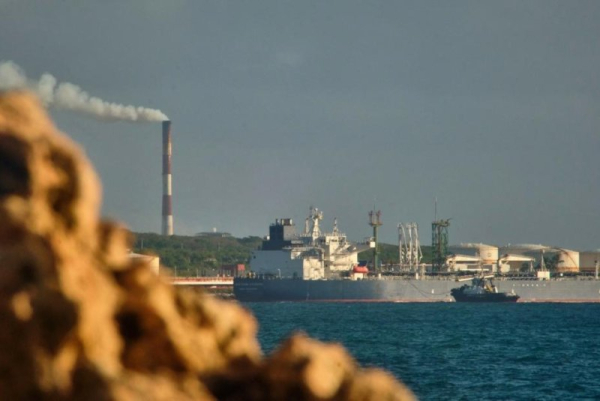
The Russian oil tanker Anatoli Kolodkin steers into Matanzas Bay, Cuba, on March 31, marking the island’s first major oil shipment in three months. The United States did not intervene, despite its announced blockade of Russian oil headed to he island nation. Photo by EPA
A floating power ship operated by the Turkish company Karpowership has returned to Cuba to support the island’s strained electricity system, as authorities seek to stabilize supply amid a prolonged energy crisis.
The vessel, Belgin Sultan, rejoined Cuba’s grid after arriving in Havana, according to Turkish media reports on Monday. The deployment is part of what officials described as assistance from Turkey to help address widespread power shortages that affect millions of residents.
Turkey’s floating power plant model is considered a rapid solution for this type of crisis. These facilities can be connected to the grid quickly and provide a stable energy supply without the need to build permanent infrastructure, Türkiye Gazetesi reported.
Cuba’s Ministry of Energy and Mines of Cuba said on X that two floating units — Belgin Sultan and Erol Bay — are in the country and have a combined installed capacity of 124 megawatts. Authorities said the ships are expected to begin to generate electricity in the second half of April.
Actualmente se mantienen 2 patanas en #Cuba Belgin Sultán y Erol Bay, con una capacidad instalada de 124 MW. No se ha incorporado ninguna otra en las últimas horas. A partir de la llegada del combustible ruso, estarán generando electricidad en la 2da quincena del presente mes. pic.twitter.com/Gk5qGRPbVc— Ministerio de Energía y Minas Cuba (@EnergiaMinasCub) April 6, 2026
The government did not specify when Belgin Sultan arrived on the island or where it is operating.
Cuba has pursued a multi-pronged strategy to stabilize its power supply, including expanding solar energy installations and relying heavily on fuel imports from Russia.
The effort follows the recent arrival of 700,000 barrels of Russian crude aboard the tanker Anatoly Kolodkin, which docked at the port of Matanzas. A second shipment is en route, Russian Energy Minister Sergei Tsivilev said.
In a statement cited by Turkish outlet NTV, Karadeniz Holding said the current operation is not a new investment, but rather a resumption of existing activity.
“Facilities in the region had been unable to generate electricity due to fuel shortages. With the recent restoration of supply, existing ships have returned to operation. Therefore, this activity does not constitute a new investment or expansion, but rather the stabilization of ongoing operations,” the company said.
It added that the initiative is considered a humanitarian project aimed at meeting the Cuban population’s basic needs.
According to the company’s website, Karpowership operates the world’s only fleet of floating power plants and developed the Powership concept, described as the first of its kind globally.
The Belgin Sultan can operate on liquefied natural gas or diesel fuel and generate up to 76 megawatts of electricity, enough to supply thousands of homes and critical infrastructure.
Cuba has used floating power ships in the past as a temporary solution to deficits in its national grid. At one point, the island operated up to eight such units simultaneously, according to local media CubitaNow.
However, the last Turkish power ship left Cuba in May 2025 after authorities were unable to cover operating costs. Data from that year showed a single vessel could cost up to $172,800 per day to run, with an estimated generation cost of about 9 cents per kilowatt-hour, Periodico Cubano reported.
