


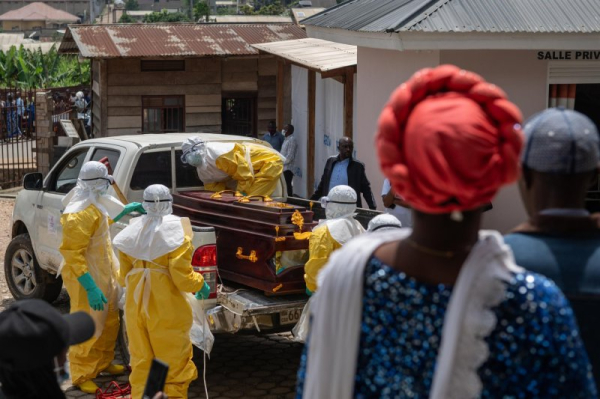
Health workers wearing full personal protective equipment prepare to transport the body of an Ebola victim in Bunia, Ituri province, Democratic Republic of the Congo, on May 23. Health officials announced Sunday that the number of Ebola cases in the country has surpassed 1,000. File Photo by EPA
The number of Ebola cases in the Democratic Republic of Congo has surpassed 1,000, according to the Congolese government.
The Ministry of Health said Sunday in a statement that there were 904 suspected and 101 confirmed cases of Ebola in three provinces and 11 health zones as of Saturday. There have been at least 10 deaths in the country, according to the U.S. Centers for Disease Control and Prevention.
“Health authorities continue surveillance, screening and awareness activities in the affected areas,” it said.
“Vigilance and adherence to prevention measures remain essential.”
The outbreak affecting the DRC and Uganda is caused by the Bundibugyo virus, with the first suspected case reported in a DRC health worker on April 24. The health worker later died.
Uganda has five confirmed cases and one death, after reporting three additional cases on Saturday.
The DRC declared the situation its 17th Ebola outbreak on May 15, followed by the WHO declaring the epidemic a health emergency of international concern the next day.
On Friday, the WHO raised the national risk assessment for the DRC to “very high,” its highest risk category, citing the risk the epidemic poses to the nation’s public health, while the region’s risk remains “high” and the global risk remains “low.”
Of concern to health officials is violence in the center of the outbreak of northeastern Ituri province, which has caused mass displacement. The United Nations also said the region harbors a “deep mistrust of outside authorities.”
“The violence is forcing people to flee, including health and humanitarian workers,” WHO Director-General Tedros Adhanom Ghebreyesus said in a social media update on Sunday.
“This is severely impeding efforts to scale up Ebola contact tracing and identify infections early enough to provide supportive care. Ongoing insecurity and fear are also fueling mistrust within communities.”
Ituri province has been affected by intercommunal violence since late 2017, and the United Nations’ humanitarian agency said hostilities expanded in 2025 across Ituri, North Kivu and South Kivu.
The U.N.’s International Organization for Migration said that of the 5.3 million people internally displaced in the DRC, nearly 922,000 were in Ituri.
