


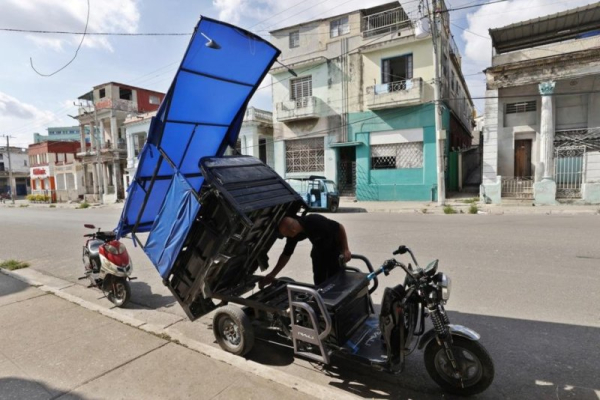
A person performs mechanical work on an electric tricycle in Havana on Thursday. The Cuban government acknowledged that the National Electric System is in critical share, with blackouts in Havana exceeding 22 hours a day in recent days, while in other provinces the outages have lasted two consecutive days. Photo by Ernesto Mastrascusa/EPA
The United States has made formal a $100 million humanitarian aid offer for Cuba, while the island’s government said for the first time it is willing to hear the proposal amid massive blackouts, fuel shortages and growing political tensions between Havana and Washington.
The reaction marks a shift from the Cuban foreign minister’s initial position. Bruno Rodríguez Parrilla publicly denied that Havana received a formal proposal from Washington and described statements by Secretary of State Marco Rubio as a “fable” and a “$100 million lie.”
However, in a new message published Thursday on X, Rodríguez said that “for the first time, the U.S. government is publicly formalizing, through a State Department statement, an offer of aid to Cuba valued at $100 million” and said Havana is “willing to hear the characteristics of the offer and the way it would materialize.”
Por primera vez, el gobierno de #EEUU formaliza de manera pública, mediante un comunicado del Departamento de Estado, un ofrecimiento de ayuda a #Cuba valorado en 100 millones de dólares.
Sigue sin aclararse si será ayuda en efectivo o material, y si se destinará a las… pic.twitter.com/GjOhrfkupt— Bruno Rodríguez P (@BrunoRguezP) May 14, 2026
Rodríguez said Cuba “does not have a practice of rejecting foreign aid that is offered in good faith and for genuine cooperation purposes,” although he insisted any assistance must be free of “political maneuvers” and suggested that institutions such as the Catholic Church could participate in distribution.
Even so, he reiterated Havana considers U.S. sanctions and energy restrictions to be the main cause of the current crisis.
“The best help that the U.S. government could provide to the noble Cuban people at this or any other moment is to de-escalate the blockade measures,” he said.
The statements coincided with a worsening energy emergency on the island.
Energy and Mines Minister Vicente de la O Levy said on state television that Cuba has “absolutely no diesel left,” and that fuel reserves for electricity generation are nearly exhausted.
He said the Cuban electric system depends on domestic crude oil, natural gas and renewable energy. A Russian shipment of 730,000 barrels delivered in March has been depleted.
“In Havana, blackouts are already exceeding 20 or 22 hours a day,” O Levy said.
President Miguel Díaz-Canel attributed the energy deficit to what he described as a U.S. “criminal siege” and said the country recorded a shortfall of nearly 2,000 megawatts overnight.
The State Department reiterated Wednesday that the aid offer remains available and said the funds would be channeled through the Catholic Church and independent humanitarian organizations if authorized by the Cuban government.
The State Department is publicly restating the United States' generous offer to provide additional direct humanitarian assistance to the Cuban people.
The Cuban regime must decide whether to accept our offer or deny life-saving help for the Cuban people, who desperately need it.— Department of State (@StateDept) May 13, 2026
Washington also said Havana had previously rejected private assistance proposals, including support for satellite Internet access.
The exchange comes amid a new escalation in tensions after President Donald Trump again tightened sanctions on Cuba and expanded restrictions on fuel supplies to the island.
On May 7, the State Department sanctioned the military conglomerate GAESA, the company Moa Nickel S.A. and executive Ania Guillermina Lastres Morera, accusing them of diverting resources while the country’s energy infrastructure collapses.
At the same time, former high-ranking commander of Cuba’s Revolutionary Armed Forces and longtime dissident Rafael del Pino delivered an unprecedented message to Cuban military personnel, urging them not to repress the population or “shed blood” to defend “the Castro family and the GAESA mafia.”
In comments to Martí Noticias, Del Pino said the Cuban leadership had lost its “moral strength” to remain in power and contended that military personnel suffer the same shortages as the rest of the population.
“The enemy today is not in Washington, but in the Castro family and its GAESA monopoly,” he said.
Del Pino cited the scale of the country’s deterioration, saying that after more than six decades of dictatorship, “Cuba has already fallen below Haiti in most economic and social indicators.”
He also supported Washington’s humanitarian proposal, describing it as a “very generous” offer that could pave the way for broader economic and financial changes in the event of a political transition in Cuba.
