

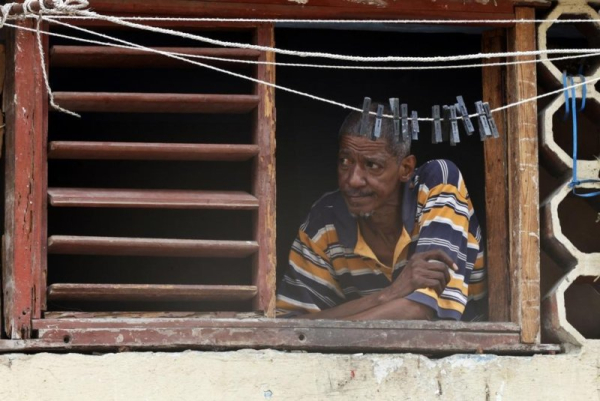
A man looks out a window in Havana during a nationwide power outage Tuesday. Cuba has been facing a severe energy crisis since mid-2024, and the U.S. oil embargo that began in January has brought the economy near a standstill, fueling growing social unrest. Photo by Ernesto Mastrascusa/EPA
Cuban President Miguel Díaz-Canel rejected what he described as public threats by the United States against his country and said any attempt at external aggression would face an “impregnable resistance.”
“The United States publicly threatens Cuba, almost daily, with overthrowing the constitutional order by force,.” Díaz-Canel said on Tuesday in a message posted on X.
He contended that Washington uses the island’s economic hardship as an “indignant pretext,” adding that the Cuban economy has been “attacked and subjected to isolation for more than six decades.”
#EEUU amenaza públicamente a #Cuba, casi a diario, con derrocar por la fuerza el orden constitucional. Y usa un indignante pretexto: las duras limitaciones de la debilitada economía que ellos han agredido y pretendido aislar hace más de seis décadas.
Pretenden y anuncian planes…— Miguel Díaz-Canel Bermúdez (@DiazCanelB) March 18, 2026
Díaz-Canel’s remarks came in response to comments Monday by President Donald Trump, who said it would be “an honor to take Cuba” and that he could do “whatever I want” regarding the island.
Over the past two weeks, Trump has referred to Cuba’s economic and energy crisis, citing widespread fuel shortages and prolonged blackouts across the country.
The situation has intensified since the United States renewed its national emergency declaration regarding Cuba, a legal measure that allows the president to impose economic sanctions and special restrictions under federal emergency powers.
The declaration provides the framework for maintaining and expanding financial and trade sanctions against the island.
Díaz-Canel accused Washington of announcing plans to “take over the country, its resources, its properties and even the very economy they seek to suffocate in order to defeat us.” He said current U.S. policy amounts to a “fierce economic war” applied as “collective punishment against the entire people.”
“In the worst-case scenario, Cuba has one certainty: Any external aggressor will face an impregnable resistance,” he said.
Secretary of State Marco Rubio told reporters Tuesday at the White House that recent economic measures announced by Cuba’s government are insufficient to reverse the island’s structural crisis. He said deeper changes are needed and that Cuba requires “new leaders.”
Rubio conditioned any sanctions relief on significant political reforms.
Relations between Cuba and the United States are at one of their most tense points in years. While both governments have acknowledged diplomatic contacts, the public exchange of accusations has escalated rhetoric on both sides.
On Monday, Cuba experienced its sixth nationwide blackout in 18 months after a failure in the National Electric System left nearly 10 million people without power and basic services, including communications. The collapse highlighted the strain on aging infrastructure and limited fuel supplies.
Shortly after 6 p.m. Tuesday, the national power grid resumed interconnected operations across the country, from the westernmost province of Pinar del Río to the eastern province of Guantánamo, the official newspaper Granma reported.
Cuba’s Electric Union said on its official channels that all provinces now have electricity service, but power outages persist nationwide due to a generation deficit.
Cuba operates a centralized electrical system, so when a “total disconnection” occurs, the entire country is left without power.
Recurring blackouts have slowed industrial activity and disrupted public services across the island. The situation has triggered recent citizen protests in several cities, some of which turned violent and led to arrests.
According to Infobae, the nongovernmental organization Cuban Observatory for Human Rights reported that authorities arrested 15 people for participating in recent protests. Of that group, 12, including two minors, remain in custody or lack official confirmation of their release.
In its report, the organization said it documented at least 35 repressive actions between March 13 an 16, targeting protesters, journalists, activists, relatives of political prisoners and opposition members.
The group also warned of “threats, permanent police surveillance of homes, house arrests and police brutality against protesters,” and said “these events show a pattern of pressure and control aimed at silencing protest and restricting the exercise of fundamental rights.”
